This guide introduces SEO, why it matters, the different types of SEO and their role in website visibility.
SEO, or search engine optimisation, is work intended to help a website be discovered, understood and considered for relevant organic search results. It connects useful information with the needs people express through search.
The objective is relevant visibility that supports the website’s purpose. A first-page ranking is not a guarantee of suitable visits, enquiries or sales.
SEO is part of digital marketing and can support websites selling products, explaining services or publishing specialist information. Its value depends on the audience, the offer and the ability to implement useful improvements.
Prominent results can be easier to notice, but clicks also depend on the query, presentation and other search features.
This introduction explains the main areas of SEO work in 2026.
Websites, devices and search products change over time.
People can search through typed queries, voice or images, and some interfaces provide generated answers alongside source links.
The sections below explain how these changes relate to practical website work.
SEO, SEM and PPC
SEM and PPC are related terms used in search marketing.
Distinguish the terms before comparing costs or results.
Their use varies between organisations, so define them in a proposal.
SEO and SEM
SEM means search engine marketing.
It can describe the broader field of organic and paid search, although it is also commonly used specifically for paid search.
In this guide, SEM is the broader term and SEO is the organic part.
- SEO : work on unpaid search visibility.
- SEM : the broader organic and paid search activity as defined here.
- PPC : a pay-per-click advertising model, which can be used in search and other environments.
SEO and paid search can form complementary parts of a search plan. This does not mean every business needs both at every stage.
Comparing SEO and PPC
PPC (pay-per-click) means the advertiser pays when a qualifying click occurs under the platform’s terms.
In a search campaign, an advertiser can use keywords and other supported controls to determine where its advertising may be eligible. Auctions and other platform rules affect delivery.
A matching or related query may create an opportunity for the ad to appear. A bid does not guarantee top placement or a sale.
The distinction is:
- with PPC, clicks are charged under the advertising model;
- with SEO, organic placement does not carry a per-click fee, but research, content, implementation and maintenance still cost resources.
Which approach is more effective depends on demand, competition, the offer, margins and timing. Assess the mix rather than assume that using both always produces the best return.
Terminology can differ between teams.
When this guide says SEM, it means a combination of SEO organic search and PPC paid search activity.
A supplier may use SEM differently, so clarify the included services rather than argue over the acronym.
Why SEO matters
Search can be an important acquisition channel.
When assessing market research, check the original study, and its sample, date, definitions and relevance to your audience.
A historical industry share is not a forecastfor your website or a reason to assume Google has the same share in every market.
Likewise, an industry market-size forecast does not establish a profitable opportunity for an individual business.
Search helps people investigate questions and options. Its relevance to the business should be assessed through the audience’s actual needs rather than a claimed total number of indexed pages or a universal figure for the size of the web.
People may search to learn, compare, navigate, solve a problem or buy. Those purposes need different kinds of pages.
A fragmented discovery environment
Discovery takes place across several platforms, not only general web search.
People may use:
- Google or Microsoft Bing;
- YouTube, TikTok or another relevant content platform;
- a marketplace such as Amazon.
When comparing research about platform use, keep its country, period and audience clear A US shopping surveydoes not establish where every audience begins a purchase.
Other platforms can matter too:
- Retailer search helps shoppers compare products and availability.
- Video platforms support demonstrations, reviews and practical explanations.
- Social platforms can introduce products and provide recommendations.
Social platforms as search tools
The role of each platform varies by audience, country and product.
For example, some people use TikTok for demonstrations or instructions. That does not make it the preferred research channel for every age group or task.
A historical demographic survey should not be applied as a current universal audience statistic.
Search as an acquisition channel
For some websites, search engines provide a substantial share of relevant visits; others have a different channel mix.
Make the website accessible and useful where relevant search demand exists.
In practical terms, visibility is an opportunity to serve a need, not a business outcome by itself.
Competition in search results
Search results also contain competing formats.
Alongside ordinary website links, a result page may include:
- AI-generated answers;
- knowledge panels;
- featured snippets;
- map results;
- image results;
- videos;
- news;
- related questions;
- carousels.
The lasting value and limits of SEO
Useful SEO work can retain value after implementation, but organic traffic is not permanent or owned. Changes in demand, competitors, the website or search systems can reduce it.
Social referrals can also vary. Do not assume they are always smaller than search traffic.
SEO within a wider marketing strategy
Query research can inform a wider marketing plan.
Understanding the audience’s needs can help with:
- paid and organic campaigns;
- website information;
- social communication.
Organic search may support important actions such as conversions, useful visits or sales, depending on the objective.
A high ranking does not certify that a business or claim is trustworthy. Provide evidence that helps people assess the offer.
Types of SEO work
One way to organise the work is to distinguish technical access, content and external references.
They address different questions:
- technical optimisation helps systems and people access the site;
- content optimisation helps the page answer the need;
- off-site work concerns relevant references and public information.
Technical SEO
Technical SEO includes implementation choices that affect discovery and processing.
A coherent architecture helps crawlers and readers reach important pages.
Review how suitable public content is linked and delivered, including URL structure, navigation and internal links.
Another part of technical SEO is the page experience. Loading, responsiveness and visual stability matter to users, but no single score guarantees rankings.
Relevant checks include:
- loading performance and Core Web Vitals;
- mobile usability;
- accessible interaction;
- HTTPS;
- intrusive elements that obstruct the content.
Also consider structured datathat accurately describes visible information. Supported markup can enable eligibility for particular search presentations, not guarantee them.
The wider implementation can involve:
- hosting;
- the content management system (or CMS;);
- security and maintenance.
On-page content
A page should be useful to people and accessible to appropriate search systems. Technical presentation is not a separate excuse to write unnatural copy.
Combine audience knowledge, relevant evidence and appropriate implementation.
Useful content should:
- cover subjects where the business has a credible contribution;
- use the audience’s language naturally;
- provide original value;
- use accurate language and terminology;
- remain factually current where timing matters;
- use images or video where they help;
- resolve a real need beyond repeating existing resources;
- have a clear structure.
Readability can be supported by:
- descriptive headings;
- manageable paragraphs;
- relevant lists and emphasis;
- language suited to the audience.
Implementation checks include:
- an accurate title;
- a useful meta description;
- logical headings;
- meaningful alt text for informative images;
- suitable social-sharing metadata.
Another term used in this area is generative engine optimisation, or GEO, which concerns representation in generated answers. Products and names change; distinguish the actual service, audience and measurable outcome.
Off-site references and reputation
Some activities outside direct website editing can support discovery and recognition.
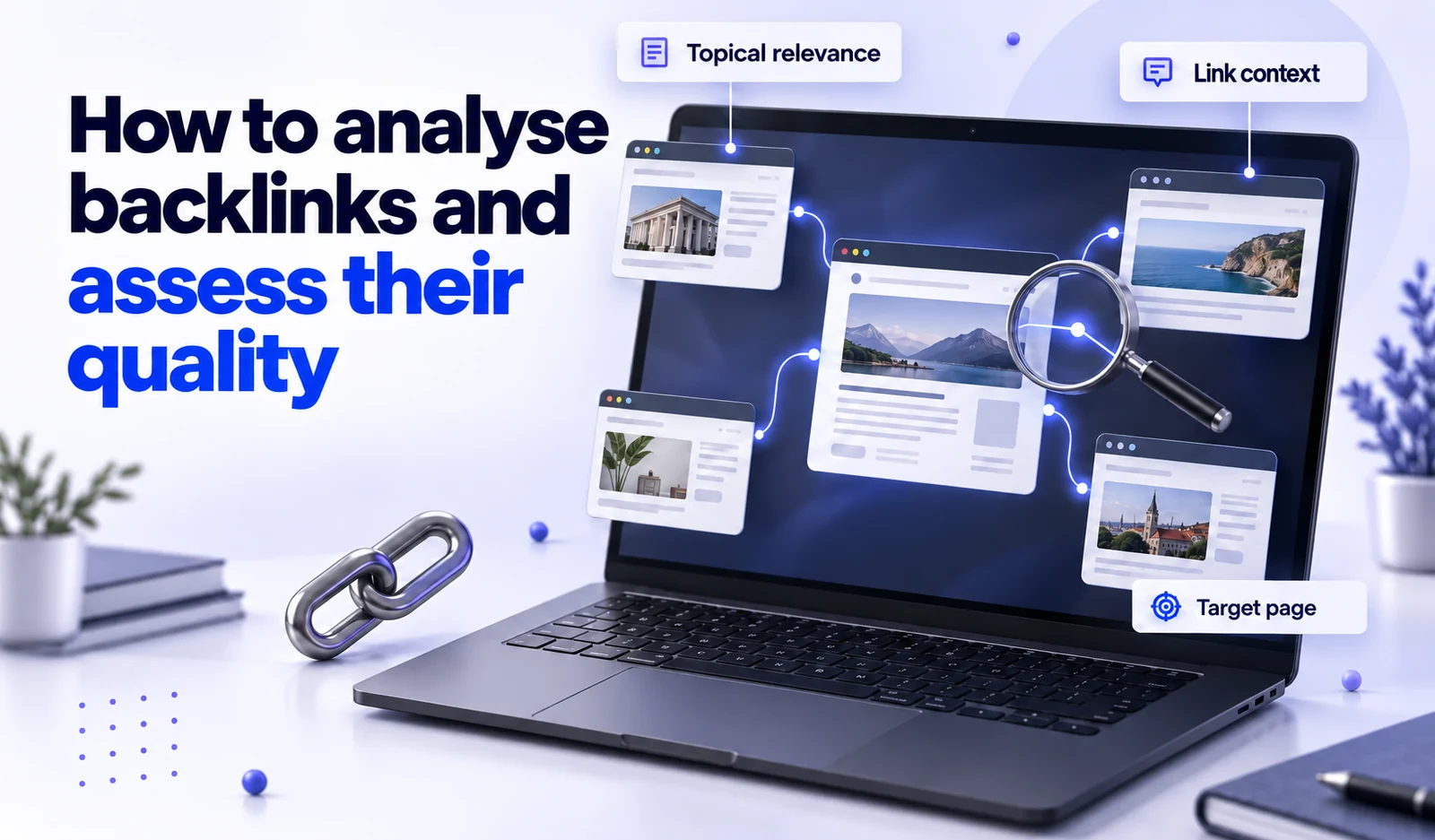
A common example is link building , understood here as earning relevant references rather than buying links to manipulate rankings.
A useful reference may help people discover information and visit the website.
Assess the editorial reason, relevance and audience. Raw link volume and proprietary scores do not establish quality.
Related activities may include:
- brand communicationthat explains the offer accurately;
- public relationswith suitable publications and genuine news;
- content marketingthrough useful resources, research or authorised contributions;
- social communicationthat reaches an appropriate audience;
- business profile managementfor relevant and accurate public information;
- review managementthat invites genuine feedback and responds responsibly.
These activities have different purposes and are not all direct ranking factors.
The useful principle is that public information affects how people encounter the business. Prioritise relevant channels rather than try to be everywhere.
Some teams call this search experience optimisation or use other broad labels. Define the actual work rather than rely on the label.
SEO specialisms
SEO also has specialist areas with different implementation needs.
Ecommerce SEO
Often includes category and product pages, filters, internal links, product information, images and appropriate structured data.
Enterprise SEO
Concerns organisational scale, governance and complex implementation. There is no universal one-million-page threshold.
Coordinating developers, product teams and stakeholders can be as important as identifying the recommendation.
International SEO
Serves audiences using different languages or markets. It can include localisation, reciprocal language annotations and market-appropriate research.
Local SEO
Concerns relevant local visibility, including eligible business profiles, accurate location information and genuine reviews.
News SEO
Requires attention to timely publication, access and appropriate news-related presentation. Fast publication does not guarantee indexing or inclusion in Top Stories.
Paywalls, article markup, dates and editorial workflows can require specialist treatment.
Six parts of an SEO process
1. Understand search systems
Know enough about the relevant product to identify access and information needs. Do not assume that one platform’s method applies everywhere.
For web search, useful concepts include:
Crawling
: discovering and fetching accessible resources.
Rendering
: processing code where supported to interpret the delivered page. Rendering capabilities vary.
Indexing
: analysing and storing information about eligible pages. Not every fetched page is indexed.
Ranking
: selecting and ordering candidate results for the query and context.
YouTube, Amazon and general web search serve different tasks and use different systems.
Social discovery also involves platform-specific mechanisms.
- Do not reduce a platform’s entire ranking process to likes, comments and shares.
- Review current primary documentation when making specific implementation decisions.
Machine learning and other complex processes also limit what can be inferred from one observed ranking change.
2. Research
Research identifies the audience need, starting position and practical opportunity.
Audience research
means understanding the target audience , its questions, constraints and reasons for choosing an offer.
Keyword research.
investigates how people express those needs in search and which results currently serve them.
Competitor research
examines relevant pages and public evidence, without assuming access to their actual revenue or analytics.
Business research
connects the work with objectives, margins, capacity and the offer.
Website review
identifies technical, content and reference issues, including questions framed by E-E-A-T guidance where relevant.
Search-result review
assesses likely intent and format expectations in the target market.
3. Planning
A strategy defines priorities, responsibilities and how progress will be reviewed.
The plan should be adaptable when assumptions or business needs change.
It may include:
- objectives;
- measurement definitions;
- milestones;
- implementation methods;
- stakeholder communication;
- tool choices;
- skills and capacity;
- budget;
- reporting;
- documentation.
4. Implementation
Research and planning need a route into actual changes.
Possible tasks include:
- justified new resources;
- improvements to existing pages;
- better internal links;
- appropriate technical corrections;
- reviewing obsolete pages before deciding whether to retain, update, consolidate or remove them.
These changes should be checked against their intended purpose. They do not guarantee a visibility increase.
5. Monitoring and maintenance
Watch for failures that affect important content and tasks.
Examples include:
- unexpected declines in relevant visits;
- performance regressions;
- changes in indexing;
- availability failures;
- broken links and other implementation errors.
6. Analysis and review
Measurement provides evidence for the next decision, although some useful fixes can also be verified directly.
Use appropriate analytics and specialist tools, which may include:
- website measurement;
- search-engine reporting;
- SEO analysis and monitoring.
Compare suitable periods and segments. Explain changes to tracking, seasonality and other factors that limit attribution.
Set reporting intervals according to the work, such as monthly or quarterly reviews, with urgent failures handled separately.
Ongoing review
SEO requires periodic review
because the website, audience and competition change.
That does not justify an unlimited commitment without evaluation. Maintain useful work and revise or stop activities that lack a clear purpose.