Search engine optimisation covers several related disciplines. The work needed depends on the business, website and audience. This guide explains common labels, how they overlap and the practical actions associated with each.
The main areas of SEO
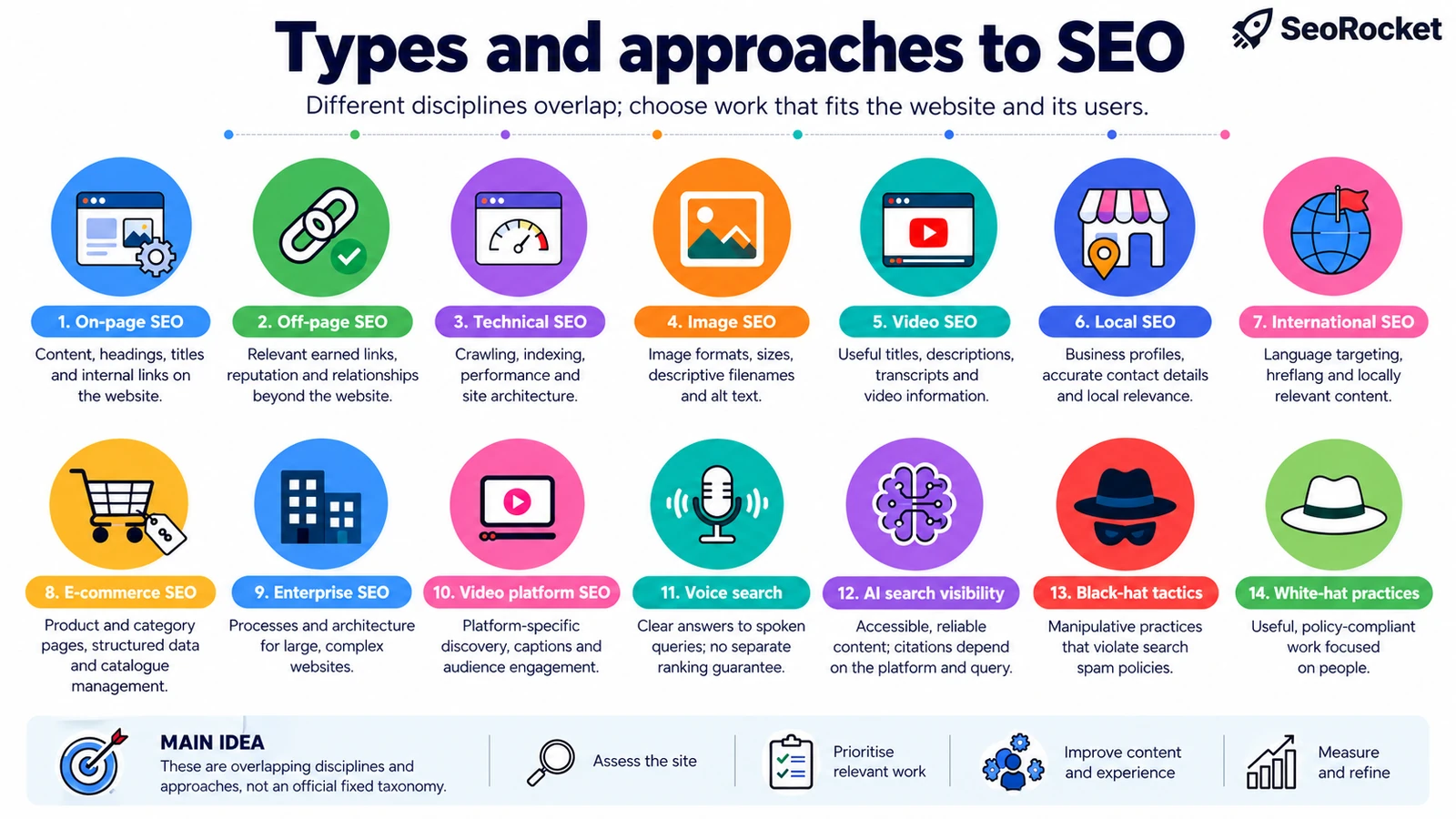
Three broad areas are often used to organise SEO work:
- On-page SEO: the content and page elements within your website.
- Off-page SEO: relevant activity and references beyond the website.
- Technical SEO : the site's technical foundations and accessibility to people and crawlers.
These areas overlap with specialisms such as local, e-commerce, international and enterprise SEO. White-hat and black-hat describe approaches to practices rather than separate audiences or page types.
What can SEO services cover?
- Our full SEO services: on-page, off-page and technical work in one plan.
- Local SEO: visibility in relevant local results and maps.
- E-commerce SEO: product and category discovery, including relevant shopping features.
- SEO audits: assessing the current position and setting priorities.
- Technical SEO: performance, indexing, site structureand accurate data markup, among other checks.
1. On-page SEO
What does it involve?
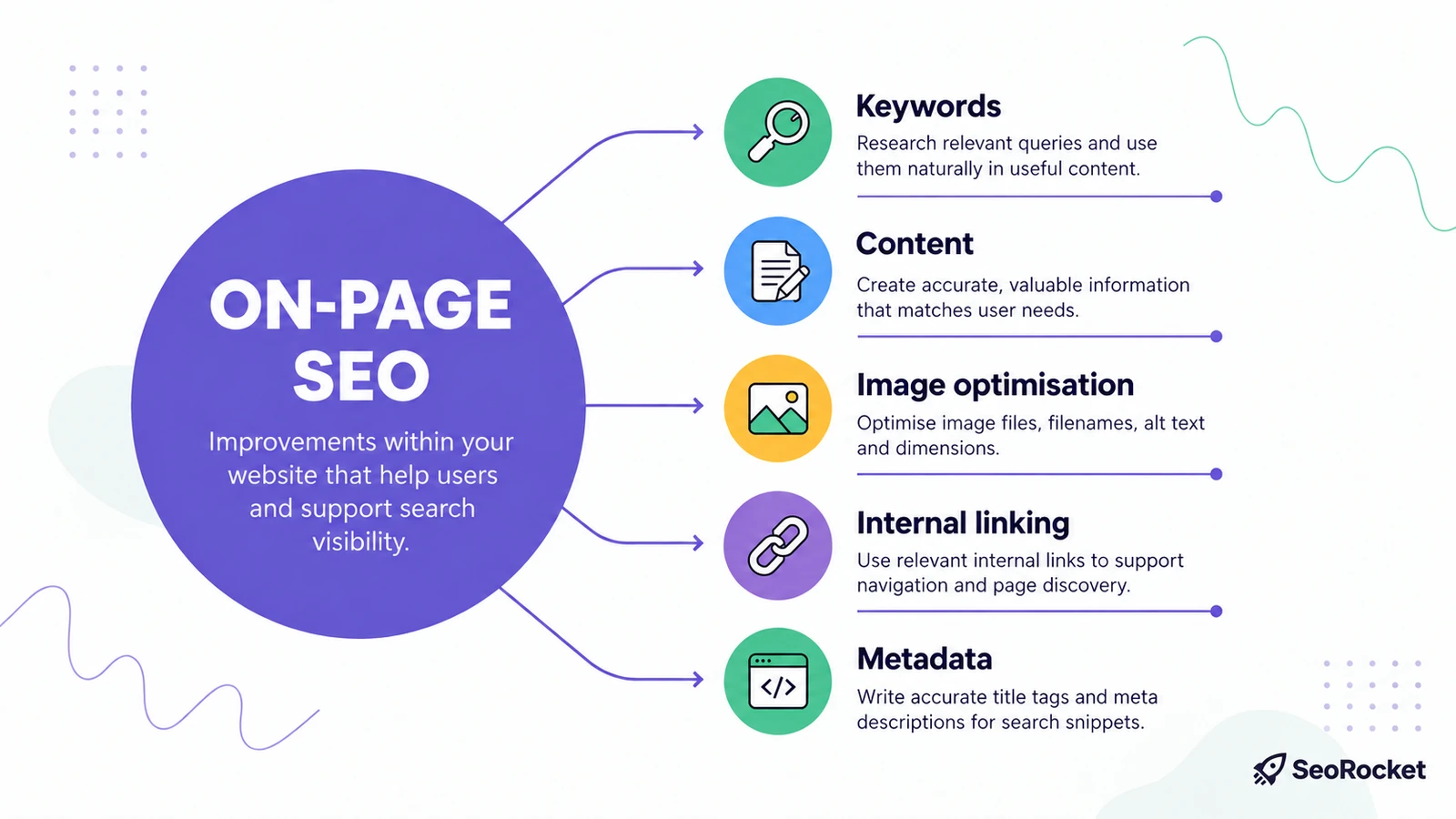
On-page SEO covers content, relevant terminology, internal links, headings, metadata and visual material within the website. Because these elements are under your control, they are often a practical place to begin, though the return depends on the actual issues.
Practical actions
- Create useful product and service pages, articles, guides, answers and evidence-based case studies.
- Carry out keyword researchand use relevant language naturally in titles, headings and content. Image alt text should describe the image's purpose, not serve as a keyword list.
- Provide clear menus, breadcrumbs where useful and an understandable page hierarchy.
- Connect related pages and appropriate priority URLwith descriptive internal links.
- Use images or video where they explain something useful, with appropriate alternatives and descriptions.
- Write distinct, accurate titles and meta descriptions that reflect the page and its intended search need.
2. Off-page SEO
What does it involve?
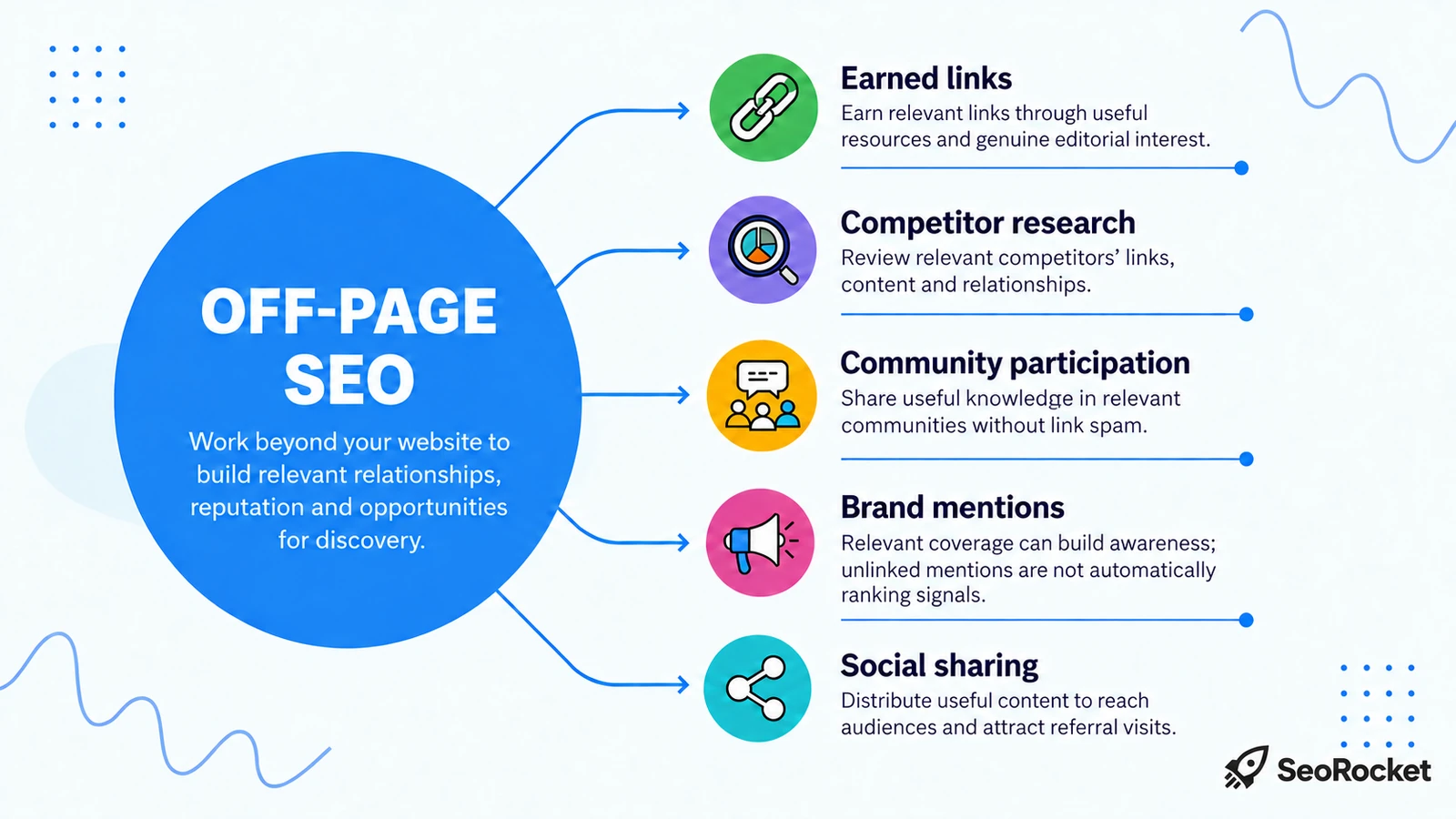
Off-page SEO concerns how a business and its content are referenced elsewhere. Relevant backlinks from other websites can play a role, alongside reputation and opportunities for discovery through communities or partners. These activities do not all function as direct Google ranking signals.
Practical actions
- Publish material worth referencing, pursue relevant digital PR opportunities and help publishers identify useful resources. Avoid guest-post or link schemes designed primarily to manipulate rankings.
- Share suitable content through social channels and include links when they help the audience.
- Participate meaningfully in relevant organisations, communities or events, with transparent sponsorship where applicable.
3. Technical SEO
What does it involve?
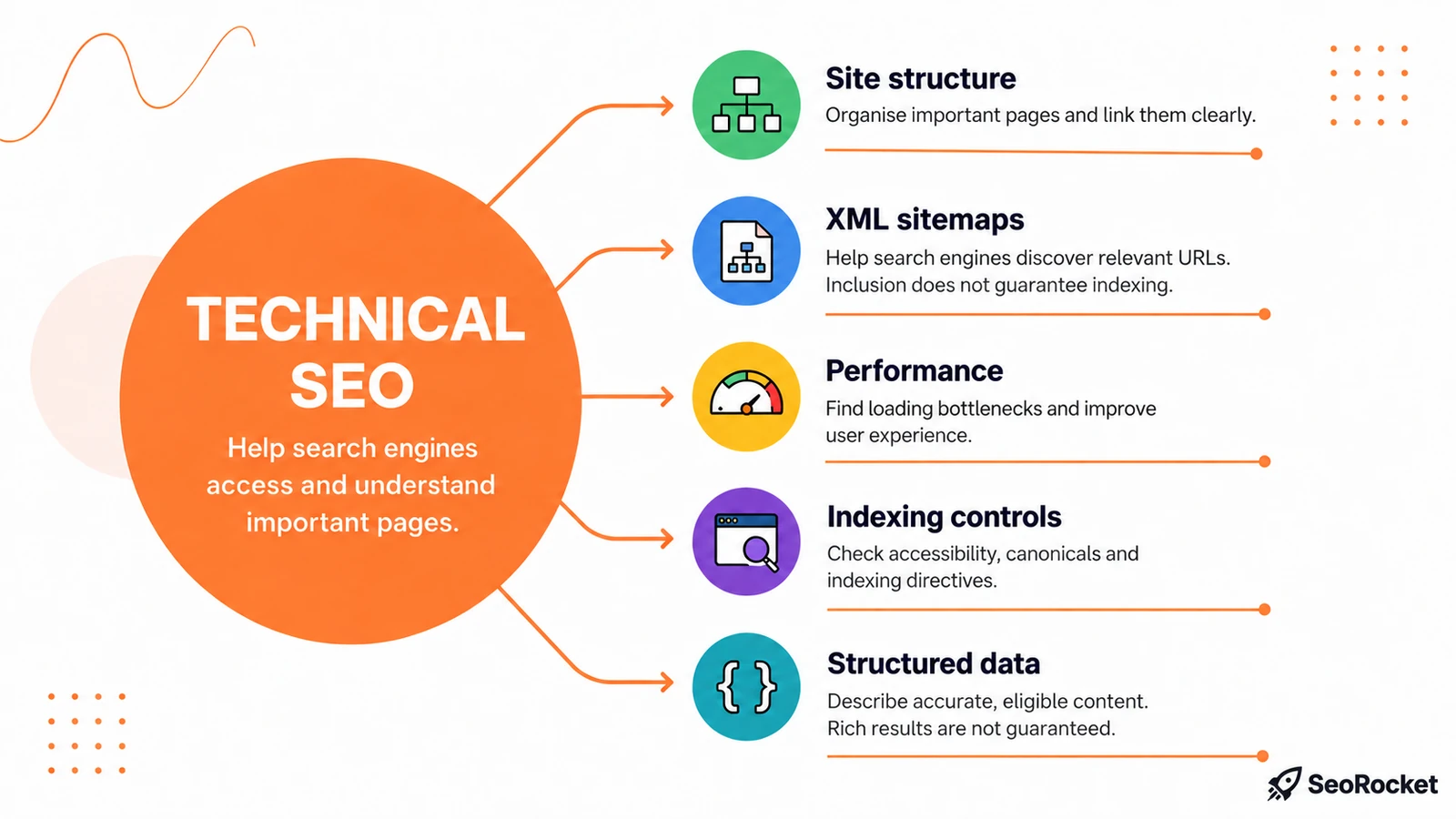
Technical SEO involves website and server work that supports crawling, indexing and use. It includes performance, stability, security and mobile access, with priorities based on the site's actual problems.
Practical actions
- Sitemaps: prepare an appropriate XML sitemap for search discovery; a visitor-facing HTML sitemap can also be useful on some sites.
- Page signals: use accurate metadata, a clear heading structure and consistent canonical declarations.
- Performance: optimise images, caching and unnecessary CSS or JavaScript, and investigate hosting or server bottlenecks.
- Mobile usability: use responsive layouts, readable text and controls that are easy to select.
- Crawling and indexing: maintain suitable robots.txt rules, indexing directives, redirects and duplicate-URL signals.
Use field data to assess Core Web Vitals for the relevant page group where available. Lab tests help investigate issues, but neither a performance score nor a fixed industry pass rate tells you how a particular page will rank.
4. Image SEO
What does it involve?
Image SEO makes visual content easier to discover, load and understand. It also supports people using assistive technology or slower connections.
Practical actions
- Formats and file sizes: use suitable modern formats such as WebP or AVIF and optimise without unacceptable quality loss.
- Names and alternative text: use descriptive filenames and alt text appropriate to the image's context; decorative images generally use empty alt text.
- Dimensions and loading: declare dimensions and consider lazy loading for off-screen images, while keeping important above-the-fold images readily available.
- Structured data where applicable: include accurate image information in supported product, recipe or article markup.
5. Video SEO
What does it involve?
Video SEO concerns videos published on your own pages and how search engines can discover and understand them.
Practical actions
- Video structured data: provide the required and relevant details, such as name, description, thumbnail and duration.
- Captions and transcripts: improve access and provide a useful text alternative where appropriate.
- Video sitemaps: consider them where they help search engines discover the site's video content.
- Hosting: choose a solution that supports performance and appropriate control over the video's presentation and discovery.
6. Local SEO
What does it involve?
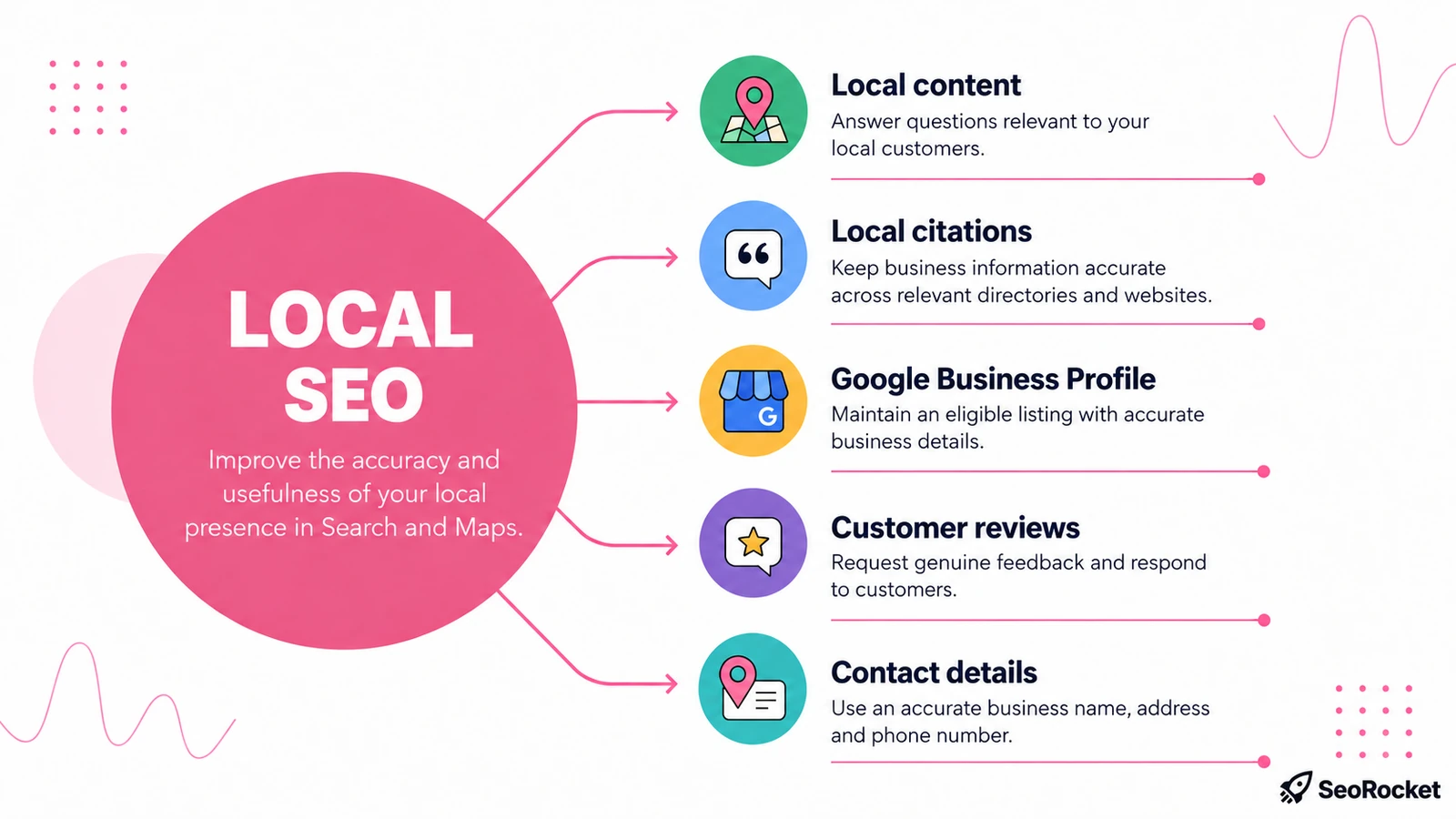
Local SEO helps an eligible business be found in the area it serves, including relevant map and local results.
Practical actions
- Local queries: explain the services and places you genuinely serve, without creating repetitive location pages.
- Business profiles: maintain accurate name, address, telephone details, opening hours and service information where eligible.
- Local references: relevant directories, community resources and genuine partnerships.
- Local content: useful location or branch information and relevant community topics.
Assess local demand and how people can contact or visit the business. Accurate profiles and relevant location information are more useful planning inputs than an unverified industry percentage.
7. International SEO
What does it involve?
International SEO supports discovery across languages and markets, with content and user experience adapted to the context served.
Practical actions
- Hreflang: identify equivalent language and regional versions correctly.
- Structure: choose directories, subdomains or separate domains around your resources and market strategy.
- Local context: account for currency, units, payments, delivery and examples relevant to the actual market.
- Translation and adaptation: write naturally without inventing local experience, offices or credentials.
8. E-commerce SEO
What does it involve?
E-commerce SEO helps people discover products and categories in organic search and eligible shopping features.
Practical actions
- Product information: accurate structured data for price, availability, identifiers and genuine reviews where applicable.
- Category pages: useful descriptions and deliberate handling of filters, duplicate URLs and canonical signals.
- Navigation and search: understandable categories and practical ways to find products.
- Product feeds: current, consistent information about products, prices and stock.
9. Enterprise SEO
What does it involve?
Enterprise SEO addresses large websites and organisations where many pages and several teams make coordination important.
Practical actions
- Governance: clear standards, templates and review cycles.
- Architecture: scalable organisation with appropriate access to important pages.
- Automation: reliable generation of metadata, internal connections or structured data where rules and checks are suitable.
- Analytics and logs: investigate crawling, performance constraints and unnecessary URL duplication.
10. Search within video platforms
What does it involve?
Video-platform optimisation concerns discovery within services where people search for and watch videos. The platform's guidance, audience and content format all matter.
Practical actions
- Titles and descriptions: describe the video's subject and match the intended search need.
- Thumbnails: show the subject clearly without misleading the viewer.
- Captions: improve accessibility and help communicate the material in text form.
- Channel organisation: use useful playlists and consistent series where appropriate.
11. Voice search
What does it involve?
Voice search involves speaking a query to search engines or voice assistants. Natural questions and concise answers can be useful, but voice queries do not require an entirely separate website.
Practical actions
- Conversational explanations: answer real questions clearly and accurately.
- Readable summaries: use lists or steps where they suit the subject, without assuming a featured snippet is guaranteed.
- Local information: maintain accurate service and location details where relevant.
12. AI search, GEO and AEO
What does it involve?
AI search products generate answers using information from several sources. Website owners may seek citations or relevant visits, but selection varies by system and query.
Practical actions
- Clarity and usefulness: provide definitions, explanations and reliable evidence where needed.
- Reliability: identify genuine authors, cite appropriate sources and maintain editorial standards.
- Structured data: describe supported information accurately, without treating markup as a citation guarantee.
- Maintenance: review material when the underlying information changes.
AI creates both opportunities and uncertainty for discovery. Assess its effect on your audience and search visibility using current evidence rather than assuming a survey prediction will describe your website's future traffic.
13. Black-hat practices
What does it involve?
Black-hat practices attempt to manipulate search systems through tactics such as keyword stuffing, deceptive content or link schemes. They can violate search policies and lead to lower visibility or exclusion.
What should you do instead?
- Avoid manipulation and focus on useful, reliable material.
- Choose quality over volume in content and promotion.
14. White-hat practices
What does it involve?
White-hat describes practices intended to serve users and follow search guidance. It is a responsible approach across local, international, image and other search contexts, rather than a guarantee of growth.
Practical actions
- Help the audience with clear answers, appropriate detail and supported conclusions.
- Maintain a sensible structure with meaningful labels, headings and internal links.
- Make visuals and controls accessible through appropriate alternatives, contrast and mobile usability.
Which area should you prioritise?
- Assess the current position: identify meaningful problems in access, indexing, performance, content or relevant references.
- Use business goals: local services may prioritise local discovery, while a shop may need product and category improvements.
- Match the plan to the available technical, editorial and promotional resources.
- Balance urgent fixes with longer-term work. The appropriate order depends on evidence, not an assumption that one discipline always delivers a faster return.
Combine the relevant areas
Combine the relevant foundations: address technical barriers, create and content optimisation, and promote useful material responsibly. Add specialist work where the business model requires it, then evaluate progress against relevant visibility and commercial goals.