SEO copy is written to help a defined audience while making the subject clear to search engines. Useful content answers a real need, uses accurate information and contributes something beyond an interchangeable rewrite. Professional SEO content writing work connects the reader’s task with the page’s purpose. It may support relevant organic visits and conversions , but neither is guaranteed by adding keywords.
Optimisation involves research, clear structure, technical presentation and editorial judgement, not a secret list of wording requirements.
This article explains practical principles for useful website copy and a workflow for planning, checking and measuring it.
How does SEO copy differ from other writing?
SEO writing should explicitly consider the audience, search intent and the page’s role. Those are also qualities of good writing in general; an “ordinary” article can be just as rigorous and useful.
Principles for SEO content
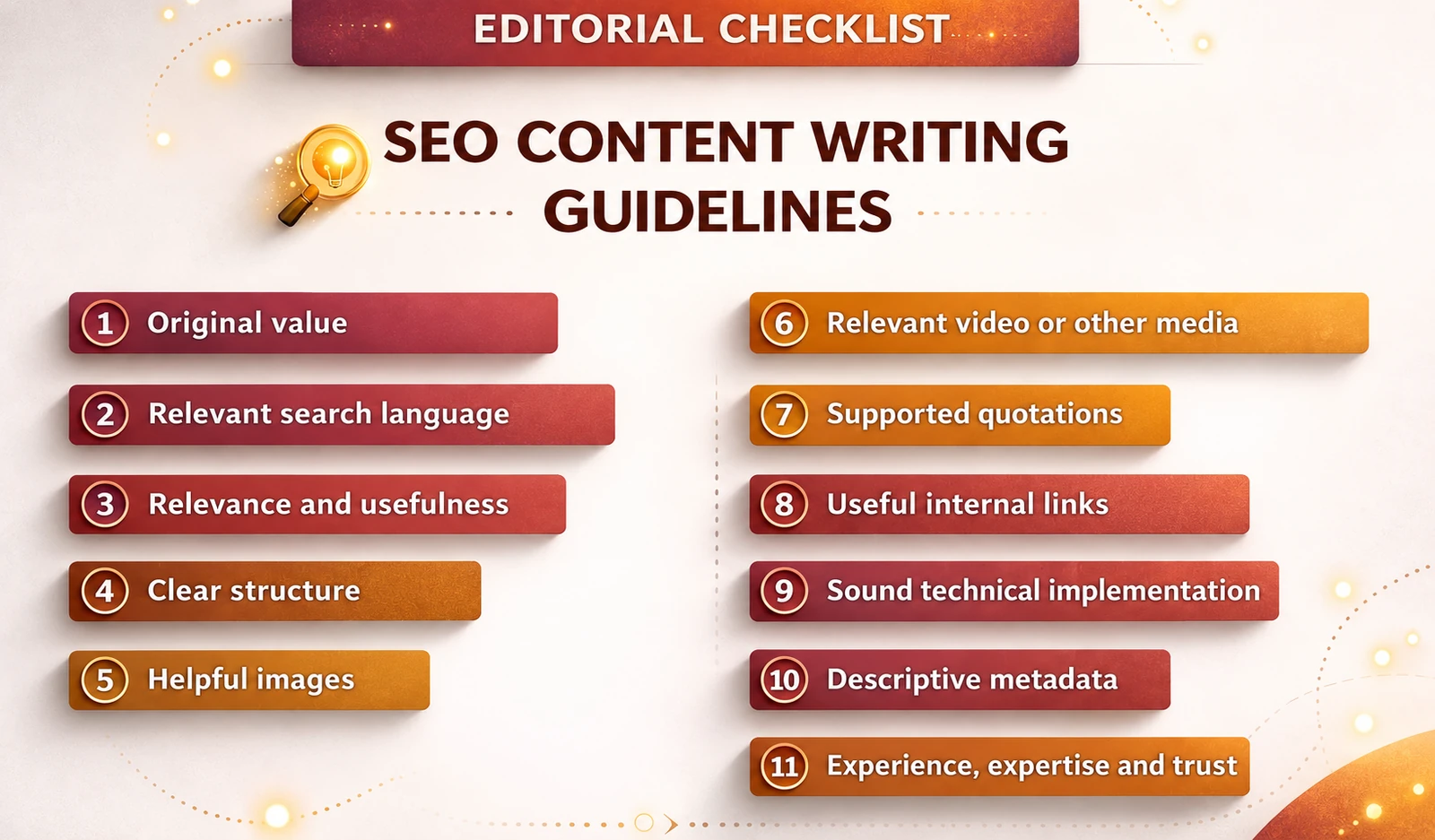
The following areas provide an editorial checklist. They are not a numerical ranking formula.
1. Provide original value
Do more than change the wording of another page. Search engines may choose one representative version of duplicate content. Ordinary duplication is not automatically a penalty, but copied material without added value can be unhelpful and may breach copyright or spam policies.
Similarity tools can identify passages worth reviewing. Their percentages are not Google requirements: there is no universal 90% originality target or 75% exception for technical writing.
2. Use relevant language
An SEO specialistresearches the audience’s searches and groups related needs into a page plan. The brief should explain the intent, scope and evidence required, not just list phrases to insert.
The writer then uses appropriate terminology naturally. Cooperation improves the relevance of the page, but a specified phrase count cannot guarantee a ranking.
3. Be relevant and useful
Give the page a clear purpose and answer the questions the intended reader needs resolved.
Related terminology can help explain the subject, but “LSI keywords” are not a Google content requirement. For example, a page about website advertisingmight discuss relevant campaign choices, audience research or search optimisationwhere they genuinely belong in the explanation.
4. Use a logical structure
Use headings to describe and organise the content. H1–H6 provide levels; most articles do not need every level.
The main heading should identify the page’s subject.
H2 headings divide the main parts of the explanation.
H3 headings group useful subsections within an H2 section.
Lower levels are appropriate when the content genuinely needs further nesting.
Manageable paragraphs, lists and emphasis help people find information. Use them because they make the explanation clearer, not because a fixed number of blocks is believed to improve rankings.
5. Add useful visuals
Images, diagrams and tables should explain something, show evidence or help the reader make a decision. Their presence alone does not earn a ranking advantage.
6. Use video where it helps
A demonstration may explain a task better than text alone. Do not add video simply to increase time on page or present that metric as a direct ranking lever.
7. Use quotations responsibly
A relevant expert quotation can add evidence or perspective. Verify the wording and attribution, link to the source where appropriate and do not invent endorsements.
8. Add relevant internal links
Link to related pages where they help the reader. For example, an article about social advertising might refer to a resource on target audience research.
9. Review the implementation
Check readability, language, links, headings and whether important content is accessible. Keyword-density and “naturalness” scores from tools are not direct search-engine requirements.
10. Write accurate metadata
Give each page a descriptive title and a suitable meta description. Search engines may use different title links or snippets. Meta descriptions can help explain a result, but are not a direct Google ranking factor.
11. Consider E-E-A-T
Experience, expertise, authoritativeness and trustworthiness are concepts in Google’s quality guidance. They help frame questions about content quality; E-E-A-T is not a single numerical ranking score.
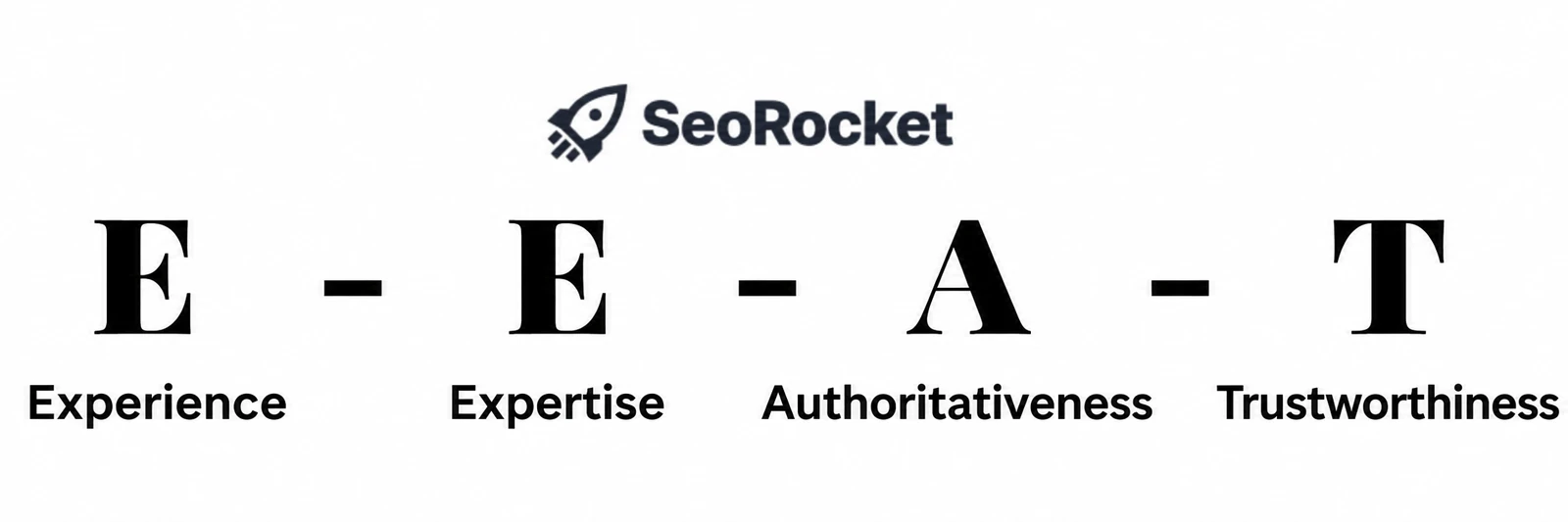
What does E-E-A-T mean?
- Experience : show genuine first-hand knowledge where relevant. A personal anecdote is not a substitute for qualified medical evidence, and a writer must not invent experience to make a page appear credible.
- Expertise : match the required knowledge to the subject. Legal, medical and other consequential advice may need suitably qualified input and current primary sources.
- Authoritativeness : consider how relevant, credible sources recognise the author or organisation. It is not established by counting all backlinks equally or by a proprietary authority score alone.
- Trustworthiness : make claims accurate and supported, identify who is responsible and provide appropriate business information. Relevant policies, website security and reputation contribute to an assessment, but a privacy page and HTTPS do not prove that every claim is trustworthy.
Writing useful SEO content involves several connected stages. Organic clicks do not have a per-click advertising fee, but research, production and maintenance still cost time and money.
The principles become more useful when applied through a practical workflow.
How to write website content for search
A clear process helps both new articles and substantive updates.
Choose a topic
Review existing content and the intended section before deciding what to add.
Assess relevance to the business and audience. Google Trends can help examine relative search interest for an appropriate term, region and period.
A rising trend is only one signal. A stable, narrow question with a genuine audience need may be more useful than a popular but unrelated topic.
Review competing results
Inspect the relevant live results, their formats and the questions they answer. Public tools estimate selected performance signals; they do not normally reveal competitors’ actual analytics.
Research terminology and missing information without copying wording or treating competitors’ phrase frequency as a target.
Select relevant queries
Choose a coherent topic and related searches according to intent. There is no requirement for three high-volume terms and fifteen additional phrases.
Possible research sources include:
- Google Ads Keyword Planner for query ideas and demand estimates, not required keyword density;
- Serpstat for supported keyword and competitor research features, according to the plan and current product;
- Keyword Tool for autocomplete-based ideas, with access and data limits depending on the version;
- Ahrefs for keyword and website research within its coverage;
- Semrush for supported research and content-assessment features, interpreted alongside direct inspection.
Use the terms needed to explain the topic. Do not distribute phrases at a fixed interval, such as every 500 characters. Repetition should follow meaning and clear language, not a density target.
Planning the structure
A simple article might use:
- a descriptive main heading;
- a brief introduction;
- a section explaining the issue;
- a section covering the practical response;
- a conclusion or appropriate next step.
This is one possible structure, not a compulsory two-section template.
- The introduction should establish the question and give the reader a useful starting answer.
- The first main section can explain relevant circumstances, evidence or the problem.
- A further section may explain options or actions. Answer the questions necessary for the task without trying to cover every possible related subject.
- A conclusion can summarise the decision or next step. Add ordering, registration, delivery or payment information only when it belongs to the page’s purpose.
Adapt the structure to the resource. A product description, a service page and a detailed guide need different relationships between information and action.
Writing and editing the draft
Write from verified source material. Research reduces uncertainty, but the draft still needs editorial judgement.
Use the query research as a language and intent check. It can inform the draft or a later review, without forcing phrases into every section.
- Make the subject clear early; there is no rule that every high-volume term must appear in the first two sentences.
- Write headings that accurately describe their sections, rather than rank keywords by heading level.
- Use terms where they belong in paragraphs, lists and tables, not to achieve even distribution.
Although this is SEO writing, the copy should remain useful and natural. Remove repetition that adds no meaning and avoid keyword stuffing.
Checking accuracy and language
An editor or subject specialist may review the draft, but the author should also check it before handover.
Review grammar, spelling, style, terminology, factual accuracy and source dates. Confirm that headings match their sections and that the explanation follows a sensible sequence.
Then check implementation and evidence rather than attempt to satisfy invented algorithm thresholds:
- review copied or closely paraphrased material, permissions and original contribution without a universal percentage target;
use appropriate language and similarity tools as aids, not as authorities on facts or ranking eligibility.
Publishing and measuring the content
Publishing is part of the workflow. Place the approved copy, images, tables and other media where they help the explanation, and check the actual desktop and mobile page.
Add accurate titles and descriptions. Fixed limits of 55 and 155 characters are not Google requirements; display varies and snippets may be rewritten. Use meaningful alt text for informative images, empty alt for decoration, logical headings and semantic list or table markup.
Measure whether the page reaches its intended audience and helps with the relevant task. Suitable observations may include:
- recorded page views;
- acquisition sources;
- relevant search clicks and impressions;
- engagement measures with clear definitions;
- reading-related events where they are actually implemented;
- completion signals, without treating a scroll as proof that someone read the whole page;
- navigation to a useful next resource or action.