
SEO, or search engine optimisation, helps a website compete for relevant organic visibility. Understanding how a search engine discovers, processes and serves pages makes it easier to identify useful work. This article separates those search-engine processes from the website team’s ongoing analysis and improvements.
How SEO works in practice
Search engines use crawlers to discover and fetch content. Indexing systems then analyse eligible pages and store information about them. When someone searches, retrieval and ranking systems select results relevant to the query and context. Crawling does not guarantee indexing, and indexing does not guarantee a prominent result.
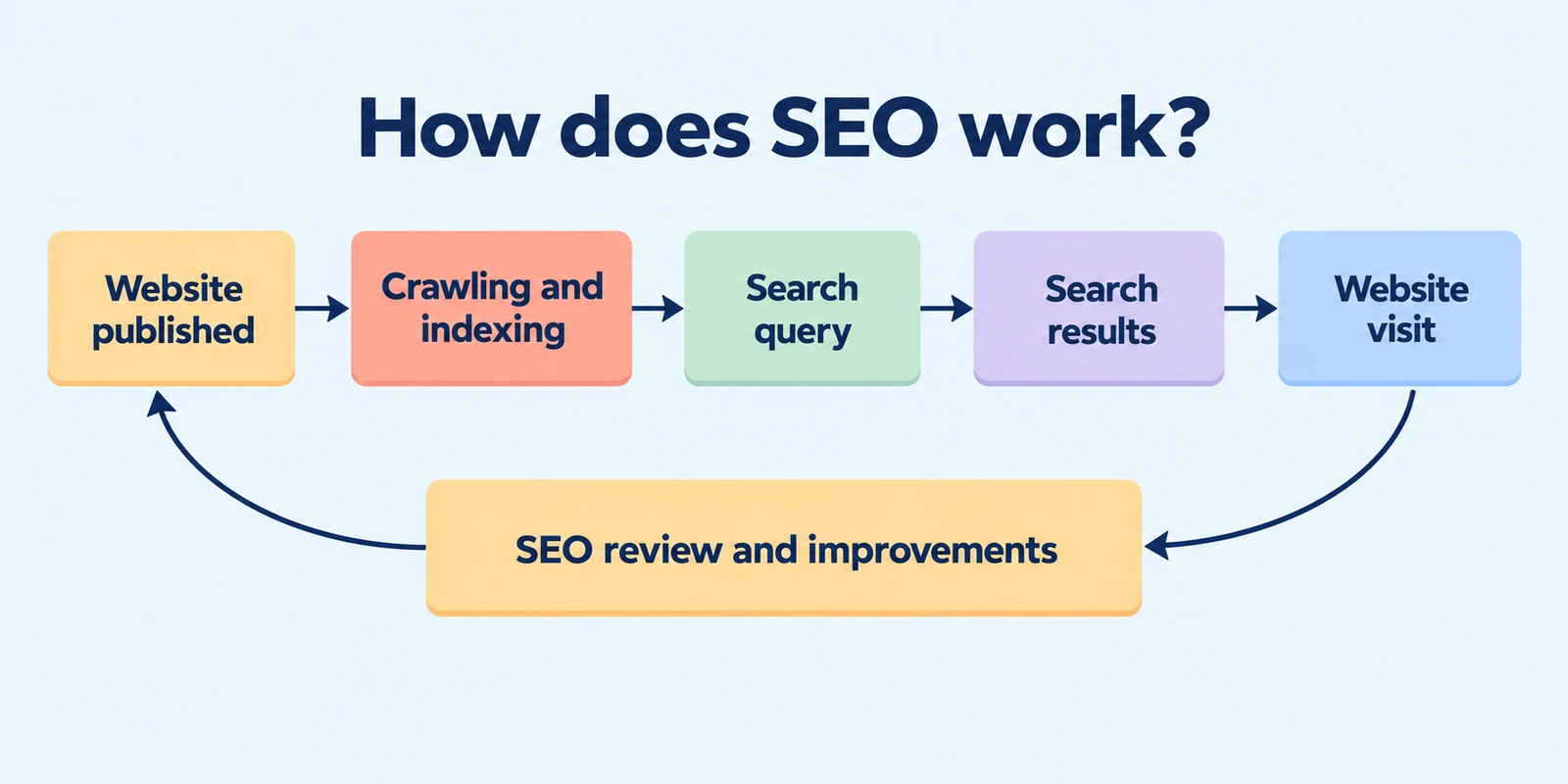
SEO improves technical access, content relevance and the experience of using the site. Its business purpose is to help the right audience find useful information and complete relevant tasks, rather than simply repeat keywords.
Understanding the main stages
The four stages below provide a simplified explanation. They are not a complete specification of a search engine’s internal systems.
1. Discovery and preparation
Before an individual search occurs, the engine discovers and processes available pages. New and changed content may need to be fetched and reassessed.
Search systems also use processes concerned with interpreting queries, context and content quality:
- Understanding intent : identifying the likely need behind the query, including cases where the wording is ambiguous.
- Applying context : results may differ according to factors such as location, language and relevant personalisation settings.
- Handling spam : systems try to identify content and behaviour that manipulate search rather than serve the audience.
The query itself and relevant context help determine which results may be useful. The exact combination of signals varies by system and search.
2. Responding to a search
When a person submits a search, the engine broadly:
- retrieves candidate results from its available information;
- assesses their relevance and other applicable signals;
- serves a selection of results in the search interface.
3. Improving the website
The website team then uses its own evidence to improve the site. This is an SEO workflow, not a claim that Google directly reads every action recorded in the site’s analytics.
- Data collection: SEO specialists gather evidence from search reports, technical checks, analytics and other relevant sources.
- Analysis: they investigate trends, constraints and useful opportunities.
- Implementation: the team makes justified changes to content, design, access or other aspects of the website.
- Monitoring: it checks the implementation and subsequent outcomes, allowing for external influences and measurement limits.
4. Reviewing feedback
Search engines also evaluate their own products through research and feedback. Separately, a business can use its website data to investigate the visitor experience.
Useful website-review measures include:
- Query relevance : whether the content answers the need behind the search.
- Recorded behaviour : interactions that the measurement setup can observe. They can reveal issues to investigate, but should not be presented as a direct list of Google ranking inputs.
- Content quality : whether the information is accurate, clear, useful and appropriately supported.
- Bounce rate : its meaning depends on the platform. In GA4 it is the share of sessions that do not qualify as engaged, not simply one-page visits.
- Session and engagement time : measures with different definitions. Longer time can reflect interest or difficulty and is not automatically better.
- Mobile usability : whether people can read, navigate and complete tasks on mobile devices.
- Page performance : loading, responsiveness and visual stability, rather than one universal “fully loaded” measure.
- HTTPS : encryption of the browser–server connection. It does not establish that the whole website is trustworthy or secure.
- Accuracy and relevance: whether information is reliable and appropriate to the reader’s need.
- Link building – Relevant links from other pages can aid discovery and provide context. Counting all backlinks equally does not establish authority.
The number of referring domains is another descriptive measure, not a complete assessment of relevance or link quality.
Why SEO matters
These processes matter because search can support several business objectives:
1. Relevant website visits
Better visibility for suitable queries can create opportunities for visits, enquiries and sales. The result also depends on demand and the presentation of the search result.
2. Brand discovery
Appearing where people research a need can introduce the business to a relevant audience.
3. Evidence of competence
Useful, well-supported information can help people assess the business. A high ranking alone is not an endorsement or proof of expertise.
4. Enquiries and sales
A relevant page and clear next step can support conversion. Actual sales depend on the offer, user experience, follow-up and other business factors too.
Key SEO terms
1. Search crawlers
Programs that discover and fetch accessible pages. Fetching is separate from indexing and does not guarantee that the page will appear in results.
2. Keywords and queries
These help inform an SEO strategyby describing audience needs and language. They guide page planning without requiring one page for every wording variation.
3. Indexing
The processing and storage of information about pages by a search engine. An indexed page can be considered for results, but inclusion and visibility are not guaranteed.
4. Ranking
Ordering candidate results according to the query, relevance and other applicable signals. It is not a simple count of keyword uses or links.
5. Searching
A person expresses a need through a query, and the search interface provides relevant results and features.
Important areas of SEO work
Content should give a clear, accurate answer appropriate to the audience and task. There is no universal length or keyword density that guarantees visibility.
Relevant language
Use descriptive titles, headings and natural terminology. Avoid keyword stuffing.
Earning references
Relevant editorial links can help people discover your work. Useful resources and appropriate partnerships may earn them; indiscriminate directory submissions or paid ranking schemes are not a substitute.
Structure and navigation
A coherent structure and internal links help people and crawlers find related information.
Technical SEO
Technical SEO includes access, indexing controls, redirects, performance and suitable structured data. Each serves a particular purpose; valid markup or a faster page does not guarantee a ranking increase.