Research into query–page pairs examined whether broad coverage or a focused answer was associated with ChatGPT citations. Its findings are useful for forming hypotheses, but they do not establish a universal citation formula.
For years, SEO discussions have often encouraged comprehensive guides: more sections, more related questions and broader coverage. That can be valuable when a reader genuinely needs it. It becomes a problem when breadth is pursued for its own sake rather than to answer the main question.
AirOps and Kevin Indig examined 16,851 queries and 353,799 pages, producing 815,484 query–page–run scoring rows. These were repeated observations, not 815,484 independent searches.
The analysis suggests three practical cautions:
- Covering more related subtopics did not consistently correspond to a higher citation rate.
- Retrieval position and query-to-heading relevance showed stronger associations within the dataset.
- Content changes should be tested against a defined audience need rather than applied as numerical rules.
The research
The research used ChatGPT’s consumer interface, with each query submitted three times. It recorded search queries, retrieved URLs and answer citations. This describes the observed workflow in the sample, not every ChatGPT response.
The work was carried out by AirOps in collaboration with Kevin Indig. Refer to the original report for methodology and the distinctions between its measures.
The sampled searches often generated a small number of additional queries. ChatGPT could retrieve pages without citing them, which makes retrieval and citation separate outcomes.
The researchers compared query and heading embeddings using the bge-base-en-v1.5 model and cosine similarity. This measured heading-level semantic similarity rather than the full quality or factual accuracy of a page.
Their fan-out coverage measure assessed how many related subtopics matched page headings at a selected threshold. That threshold is an analytical choice, not a published requirement for website owners.
In practical terms, the analysis asked whether the headings appeared to cover the subjects being searched.
Its central question was whether greater coverage of related subtopics was associated with more citations.
Topical breadth had a limited association
The report found a limited overall association between heading-level fan-out coverage and citations.
The difference weakened when the comparison accounted for how closely the page’s headings matched the original query. This matters because a broad page can also happen to be a relevant page; the two characteristics should not be confused.
The researchers therefore compared pages with stronger query-to-heading similarity separately.
Within that comparison, moderate coverage performed better than exhaustive coverage. This is an observation from the sample, not a rule to remove a fixed percentage of your content.
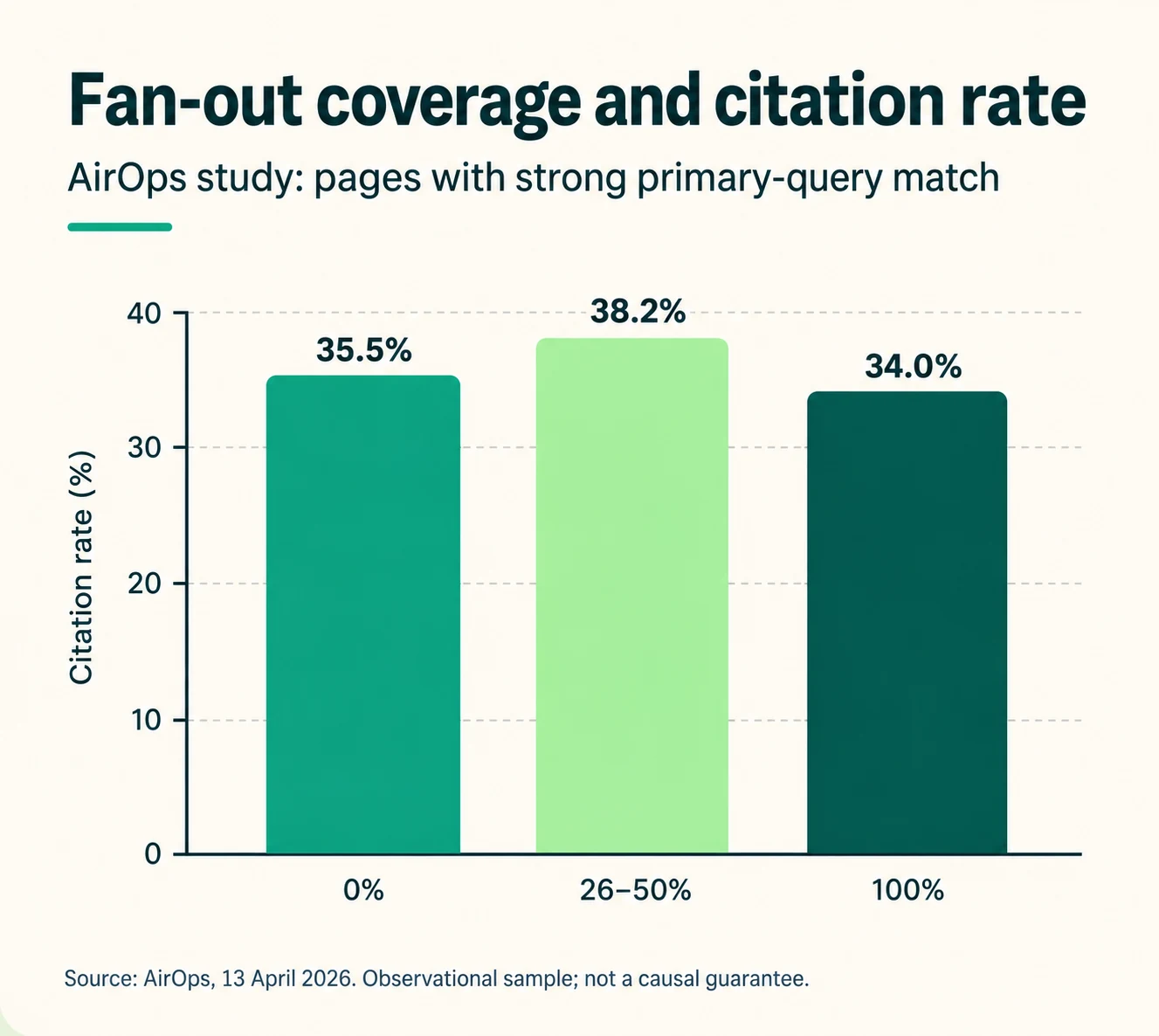
The useful lesson is to examine whether extra sections serve the main task. It is not that every comprehensive page is inferior to every short page.
A focused article can answer a narrow question well, while a long guide can serve a complex decision. Choose the scope according to the reader’s need and test the result.
What was associated with citations?
Retrieval position and query-to-heading similarity stood out in the measured relationships. Neither should be described as the only cause of citation.
Retrieval position
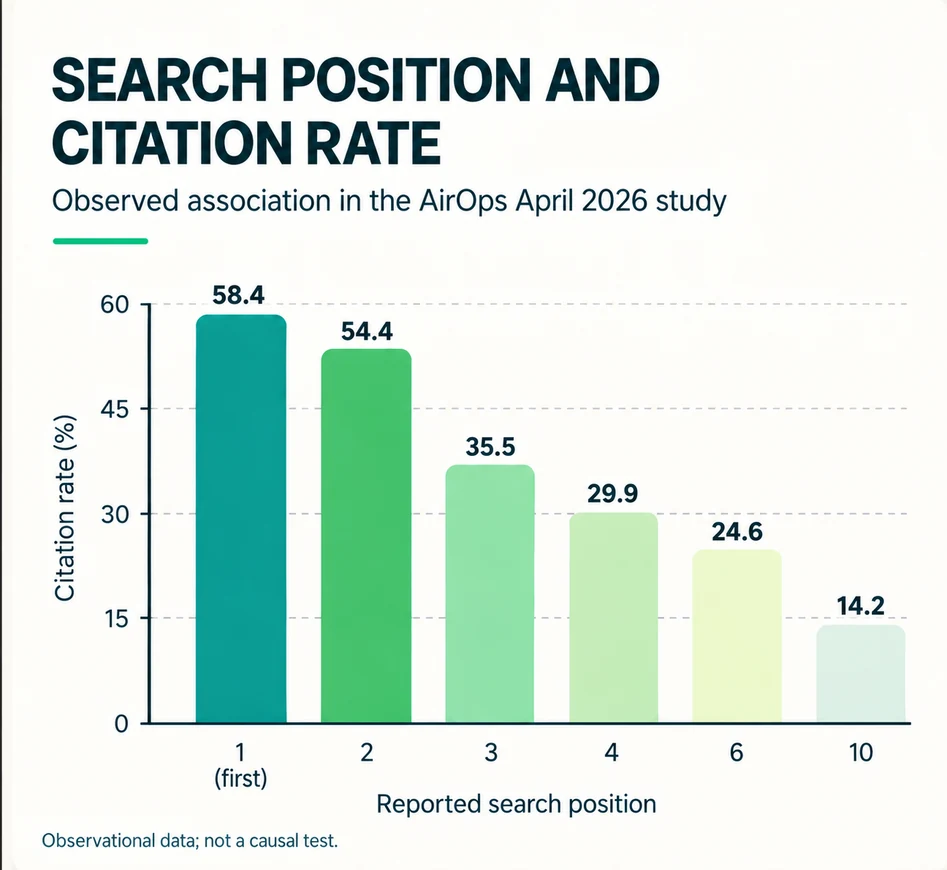
The page’s position in the search results returned to ChatGPT was strongly associated with citations in this study. The report gives approximately 58% for the first retrieved result and 14% for the tenth; these are sample citation rates, not a forecast for an individual website.
Pages cited across repeated runs tended to have better retrieval positions. Compare median and average ranks carefully: they describe different aspects of the distribution and should not be used interchangeably.
Query-to-content relevance
The research assessed relevance by comparing the original query with the most similar page heading. This is a useful structural proxy, but it does not measure all the information in the body text.
Closer heading matches were associated with higher citation rates in the sample. That does not mean copying an exact query into a heading makes a page eligible or guarantees selection.
The relationship also appeared in comparisons of highly ranked retrieved pages. It remains an observational relationship, not a controlled publishing experiment establishing the effect of rewriting headings.
Other measures included breadth, word count, heading count and third-party domain authority. Their results should not be treated as confirmation that the model directly uses or ignores any particular proprietary score.
The Wikipedia exception
Wikipedia was an outlier in the dataset.
Its citation pattern did not follow the same simple relationship with retrieval rank and heading similarity as the general sample.
Wikipedia pages also differed substantially in length, lists, tables, linking and editorial context. Comparing one page metric cannot isolate which of those factors explains its citations.
A company blog cannot reproduce an encyclopaedia’s wider context by adding more headings to one article. The practical objective is accurate, well-supported coverage appropriate to the question, rather than imitation of a large reference source.
Consistent and inconsistent citation patterns
The researchers also grouped pages according to how consistently they were cited across the sampled observations:
- Some retrieved pages were never cited.
- Others were cited whenever they appeared in the relevant observations.
- A further group was cited inconsistently.
The groups could look similar on simple measures such as length and heading count. Similar page statistics can conceal important differences in relevance, retrieval context and the information needed for an answer.
Simple on-page counts were therefore insufficient to separate reliable citations from pages that were not cited.
Retrieval position was a more useful distinction in this sample. This reinforces the need to assess discoverability and relevance alongside the content itself.
A retrieved result is an opportunity for a system to examine a source, not a guarantee that the source will be useful for the final answer.
Implications for content creation
Expanding a page to cover every possible related query is not an evidence-based shortcut. It can dilute the main answer and make the structure harder for readers to follow.
The inconsistent group does not prove that comprehensive guides are inherently unstable. Query differences, repeated appearances and the sampling method also matter when interpreting citation patterns.
For content planning, retain three practical principles:
- Use headings that accurately describe the question and answer.
- Let the task determine length; the study’s observed word-count ranges are not mandatory targets.
- Use enough sections to organise the answer, without adding a quota of subtopics.
The objective is a useful answer to a defined need. Where related questions require distinct treatments, separate resources and sensible internal links may be clearer than one sprawling page.
Improving the foundations for AI search visibility
If you want content to be usable in AI-generated answers, review AEO alongside established SEO strategies. Both labels should lead to concrete work on useful content, access, relevance and measurement rather than promises of guaranteed citation.
In practice, organise the answer clearly, use accurate headings and evidence, and make important information accessible in the page. Monitor representative questions over time because answers and sources can change.
SeoRocket can help assess those foundations and prioritise content improvements. Any proposal should define the queries, platforms, work and measurement limits; inclusion in a particular AI answer cannot be guaranteed.
Sources
Source: Search Engine Journal, “Shorter, Focused Content Wins In ChatGPT”, Kevin Indig, 2026. See also the original AirOps research linked below.