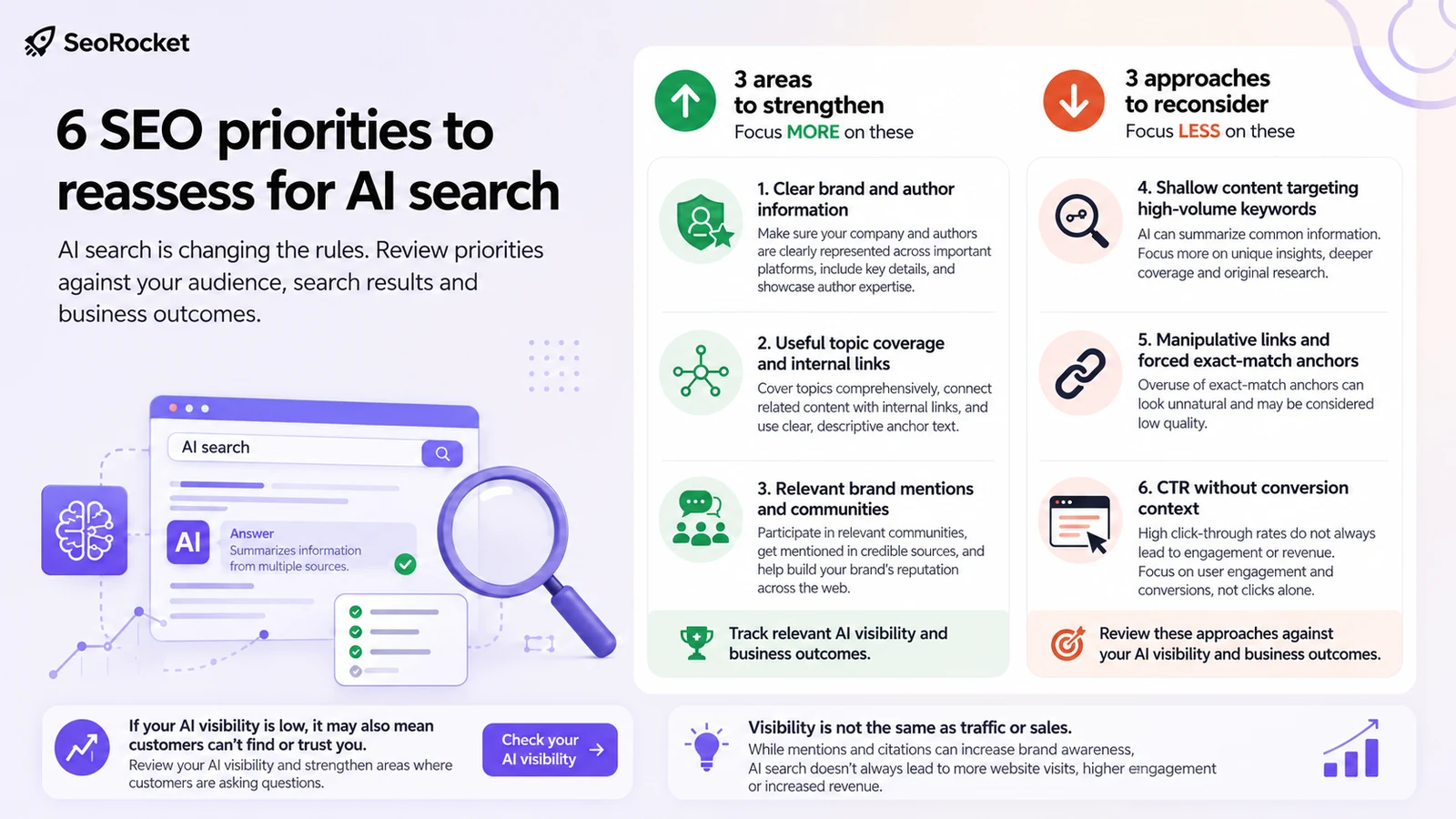
AI search is changing which SEO services activities deserve closer attention. This article considers three priorities to strengthen and three activities to reassess against actual search behaviour and business results.
SEO and AEO overlap substantially. Google's AI search features still rely on established SEO foundations; appearing in them does not require a separate set of technical optimisations. Other AI platforms use different systems, so visibility needs to be assessed individually.
The practical question is which parts of your search strategy need adjustment, rather than whether SEO has stopped mattering.
Rather than repeating advice on content formatting, this article examines brand information, topic coverage and third-party discussion, alongside activities that may deserve less investment when they do not serve a clear audience need.
3 SEO priorities to give more attention
Make your brand and expertise easy to identify
People and search systems need clear information about what a business does and who is responsible for its content. Consistent names, descriptions and credible supporting sources help reduce ambiguity. Google's Knowledge Graph has long organised information about entities, but this does not establish a universal formula for citations across AI platforms.
Review whether information about your business is accurate on relevant public profiles. These might include LinkedIn, Crunchbase and appropriate industry directories. Wikipedia requires independent notability and sourcing; it is not a promotional profile that every business should create.
PR, SEO and AI search teams should coordinate the facts they communicate. Earned media coverage can give potential customers independent information about a business, without guaranteeing that an AI platform will recommend it.
E-E-A-T also supports clear authorship and reliable information. Identify genuine subject specialists and make relevant credentials verifiable. Adding a name or profile alone does not establish the quality of an article.
Accurate brand information provides a firmer basis for useful content. Whether that content earns citations still depends on the question, platform, available sources and other factors.
Understand how AI search presents your brand.
Review where your brand appears in AI answers, which competitors are mentioned and which relevant questions your content does not yet address.
Review your AI visibility.
Build useful topic coverage through content clusters
A set of connected, substantive pages can answer the different questions people ask about a topic. A collection of thin pages targeting isolated phrases offers less help. Treat topic coverage as an editorial approach, rather than a confirmed universal AI ranking factor.
Plan around the decisions and questions your audience faces, alongside keyword data. Ask which subjects your business can explain well and where its knowledge adds something useful.
Internal links help readers and search engines find related information. Regular content audits should check missing explanations, outdated material and disconnected pages, as well as identifying weak content.
Detailed coverage of a niche creates opportunities to answer several related questions. Track whether those pages are actually found and cited; a cluster's existence alone does not prove wider AI visibility.
A well-maintained topic cluster can help prospective customers research a problem before contacting a supplier. Customer feedback and referral data can indicate whether AI tools played a part, though neither provides a complete account of the buying journey.
Monitor unlinked brand mentions and relevant communities
AI systems can use a range of sources, not only pages with backlinks. A mention in Reddit, Quora, an industry forum or a professional community may provide useful context even without a link. Whether a platform uses a particular discussion varies.
Independent discussion can reveal how people describe your business, what they trust and where information is inaccurate. This is useful research in its own right; it should not be presented as a proven citation mechanism shared by all AI systems.
Relevant communities can contain detailed first-hand accounts, but they also contain errors, promotion and unverified claims. Assess individual discussions rather than treating every Reddit mention as authoritative.
Community participation and digital PR can complement SEO when they help a real audience. Contribute useful expertise, disclose commercial relationships and follow the community's rules.
Monitor unlinked mentions alongside backlinks where they help you understand reputation. Listening tools such as Brandwatch or Mention, and manual reviews of relevant discussions, may reveal recurring questions and inaccurate information; coverage varies by tool.
Ask where meaningful discussions happen, whether the information is accurate and what customers need clarified. A link count alone cannot answer those questions.
Relevant community discussion is worth reviewing when people ask for recommendations or first-hand product experiences. Genuine participation may build awareness, but an increase in AI recommendations must be measured rather than assumed.
For a smaller brand, earning credible attention in a specialist community can be worthwhile. There is no reliable universal timetable for converting that attention into AI visibility, or evidence that it always outperforms editorial links.
B2C brands can learn from authentic community feedback about product use and purchase decisions. Do not manufacture reviews or seed undisclosed recommendations in pursuit of AI mentions.
Before changing priorities, establish a baseline.
Record the queries, platforms and dates you are comparing.
Separate measured changes from assumptions about their cause.
Review whether any change helped a relevant visitor complete their task.
3 SEO activities to reconsider
Chasing high-volume keywords with shallow content
AI Overviews can change whether people click through on informational searches. A high ranking for a broad phrase therefore does not, by itself, establish how much useful traffic a page can attract.
Search volume is only one input into opportunity assessment. As an illustrative scenario, a phrase with 50,000 monthly searches could produce fewer visits than one with 2,000 if result features and user behaviour differ. These figures are an example, not a measured benchmark.
Create specific, well-supported content that answers a genuine question. Consider where visitors need a comparison, a tool, detailed evidence or a next step available on your website, rather than adding pages solely because a keyword has a large estimated volume.
Assess likely click-through behaviour alongside relevance, competition and business value. A query answered directly on the results page may still support awareness, but should not be assigned an unrealistic traffic forecast.
Pursuing manipulative links and forced exact-match anchors
Large volumes of low-quality links are not evidence that content deserves citation. For Google Search, links created to manipulate rankings can breach spam policies. Assess a publication's relevance, audience and editorial standards instead of assuming that a higher count means a stronger recommendation.
Prioritise credible coverage where your audience seeks information. Relevant trade publications and specialist blogs may be useful, but selection should follow actual audience and source research. Create material worth referring to, and qualify paid placements appropriately.
One hundred weak links are not a reliable route to a ChatGPT citation. A few relevant publications read by your target audiencesmay be more useful for reaching that audience. These are illustrative quantities, not a formula for AI visibility.
Optimising click-through rate without considering the results page
Titles and descriptions still matter. However, where users receive a sufficient answer on the results page, small wording changes may have limited impact on visits. Inspect the real search results and query–page data before deciding whether to revise a snippet, strengthen the page or pursue another topic.
Consider useful visibility within AI answers alongside ordinary search results. Transactional and navigational queries often involve a further action, but their value still depends on your offer and the user's task, rather than a fixed rule about query type.
Click-through analysis works best when it accounts for position, device, country, intent and result features. A falling CTR does not automatically mean that the title is weak or that an AI feature caused the change.
Find the questions where your brand is missing.
Monitor AI search visibility, identify relevant gaps and improve the information available to prospective customers.
Review your AI visibility.
Value does not always mean more traffic
These priorities should be tested against business outcomes. Impressions and clicks can decline without every commercial measure falling at the same rate, but a loss of traffic should still be investigated. Evaluate qualified conversions, sales opportunities and revenue using comparable periods and clear measurement limits. AI visibility does not make those outcomes automatic.