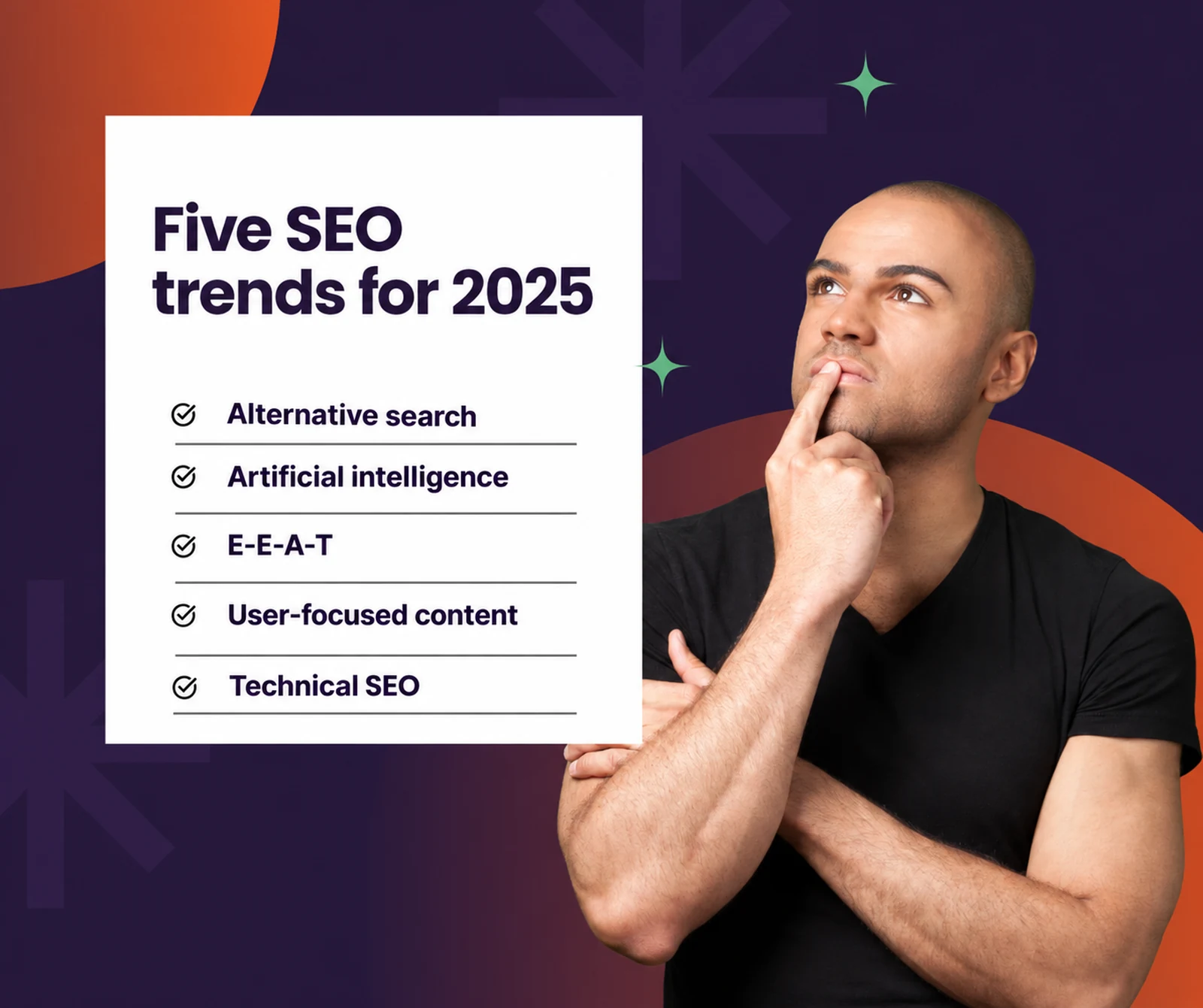
This outlook was written as 2024 drew to a close. The SEO market was changing, and the following sections describe themes considered relevant for 2025 rather than a current forecast.
Proposed remedies in Google's US search competition case raised questions about access to search data and the opportunities for alternative services. The implications for SEO specialists depended on decisions and implementation, not an automatic disclosure of Google's ranking algorithms.
AI tools also raised practical questions about efficiency and originality. Drafting can become faster, while similar prompts and unchecked outputs can produce repetitive content.
The planning challenge for 2025 was to combine useful automation with original knowledge and human review.
The five themes below show the reasoning behind that outlook.
1. Alternative search and Google's antitrust case
In late 2024, proposals concerning Google's search business included data-related remedies. Their possible effects on SEO depended on the eventual legal decisions and scope of implementation.
Some proposals could help rival search servicesdevelop their offerings. Access to specified data should not be confused with access to every algorithm or a complete replica of Google.
Competing services can still differ in their systems, products and user experience, even where some inputs become more accessible.
For SEO teams, the useful response is to assess where their audiences search. A fixed prediction of ten or twenty separate strategies is not a substantiated requirement.
AI assistants and answer services were already encouraging businesses to consider visibility beyond conventional web results.
Any new access to search data would need to be assessed against its actual terms. It would not automatically reveal Google's complete ranking logic.
More data can support analysis, but conclusions still require suitable definitions, context and validation.
Speculation about manipulation should not replace a strategy based on useful content and search guidelines.
Businesses should avoid assuming that a legal remedy will make low-quality content a reliable route to rankings.
At the time of this outlook, the case and remedy proposals were still developing. Read subsequent official decisions before treating these historical possibilities as current requirements.
2. AI as an assistant requiring review
A growing choice of AI products made tool selection a practical issue for SEO teams.
Useful assistance still requires boundaries. Overreliance can lead to unsupported claims and repeated strategies.
Similar generic inputs often produce similar outputs. A business needs its own facts, examples and judgements to create distinct value.
Google's discussion of E-E-A-T includes first-hand experience, which a generic draft cannot establish on its own.
Models do not expose every detail of how an answer was generated. A convincing response therefore still needs verification.
Treat unexpected or polished answers as material to inspect rather than proof of reliability.
Check important claims against suitable sources and assess the output in the context of the task.
An SEO specialist's judgement includes applying experience, business context and creative problem-solving.
Retain responsibility for the decisions rather than delegate it to the tool.
One option is to develop a task-specific AI workflow using approved information and clear instructions.
A custom implementation still needs security and privacy review. Building a tool internally does not automatically eliminate data risks.
Features such as Gemini Gems or custom GPTs can support tailored instructions, subject to current account capabilities and terms.
A tailored workflow can reflect brand language, website context and editorial requirements.
Any use of CRM, analytics or customer feedback needs appropriate authorisation, data minimisation and safeguards. Providing context is not necessarily the same as training a model.
Relevant, approved information can support more specific work and strengthen your E-E-A-T.
3. E-E-A-T and original value
Experience, expertise, authoritativeness and trustworthiness remained useful concepts for evaluating content quality in the 2025 outlook. E-E-A-T is not a single score that guarantees rankings.
Original data and first-hand expertise can help readers assess what a business knows and why its content is useful.
References to leaked API fields cannot by themselves establish a current ranking formula or the weight of a signal. Recommendations need a clearer basis than a field name alone.
Customer questions, original research and specialist explanations can inform useful topics. Use lawfully collected data and approved examples, respecting confidentiality.
These sources can reveal unanswered questions and opportunities to improve existing content or create a genuinely needed page.
Explain who created the content and what relevant expertise supports it where that helps readers assess reliability.
Accurate author information and genuine evidence can support trust among readers and search engines.
Review biographies for accuracy rather than invent qualifications or experience to fill a template.
4. User needs alongside keywords
Keyword planning is more useful when tied to a specific need and a suitable page type.
Build content around the problem a person is trying to solve and the information needed to make a decision.
A high-volume phrase can have mixed intent or results dominated by directories, forums and comparisons. Review the actual results before choosing your format.
Queries can be short phrases or detailed questions. Use research to understand your audience rather than assume everyone searches in the same way.
Focus on contentthat solves relevant customer problems. This helps avoid spending on targets whose intent does not match the offer.
Provide accurate, relevant information and a usable page. These are practical content goals rather than a promise of favourable treatment by every algorithm.
5. Technical foundations remain important
For 2025, technical SEO remained a priority: important content needs to be accessible to search engines and understandable to visitors.
Appropriate structured data, organised sitemaps, internal links and maintainable code support discovery and understanding. None guarantees a ranking gain on its own.
Accessibility and usable layouts help people interact with the page, regardless of device or assistive technology.
Claims about click-related ranking systems should be interpreted carefully. A leaked field or isolated metric does not provide a complete instruction for improving rankings.
Core Web Vitals and speed relate to page experience. Slow loading can create visitor friction, but passing a score threshold does not establish that a page will outrank competitors.
JavaScript-heavy websites need particular attention where rendering prevents important content or links from being seen.
Test rendered output and choose suitable rendering and delivery methods for the website. Server rendering is one approach, not a universal requirement for every page.
Use official Google and Bing documentation to investigate technical requirements.
Review the relevant reports in Bing Webmaster Tools and Google Search Console, accounting for access, data availability and reporting limitations.