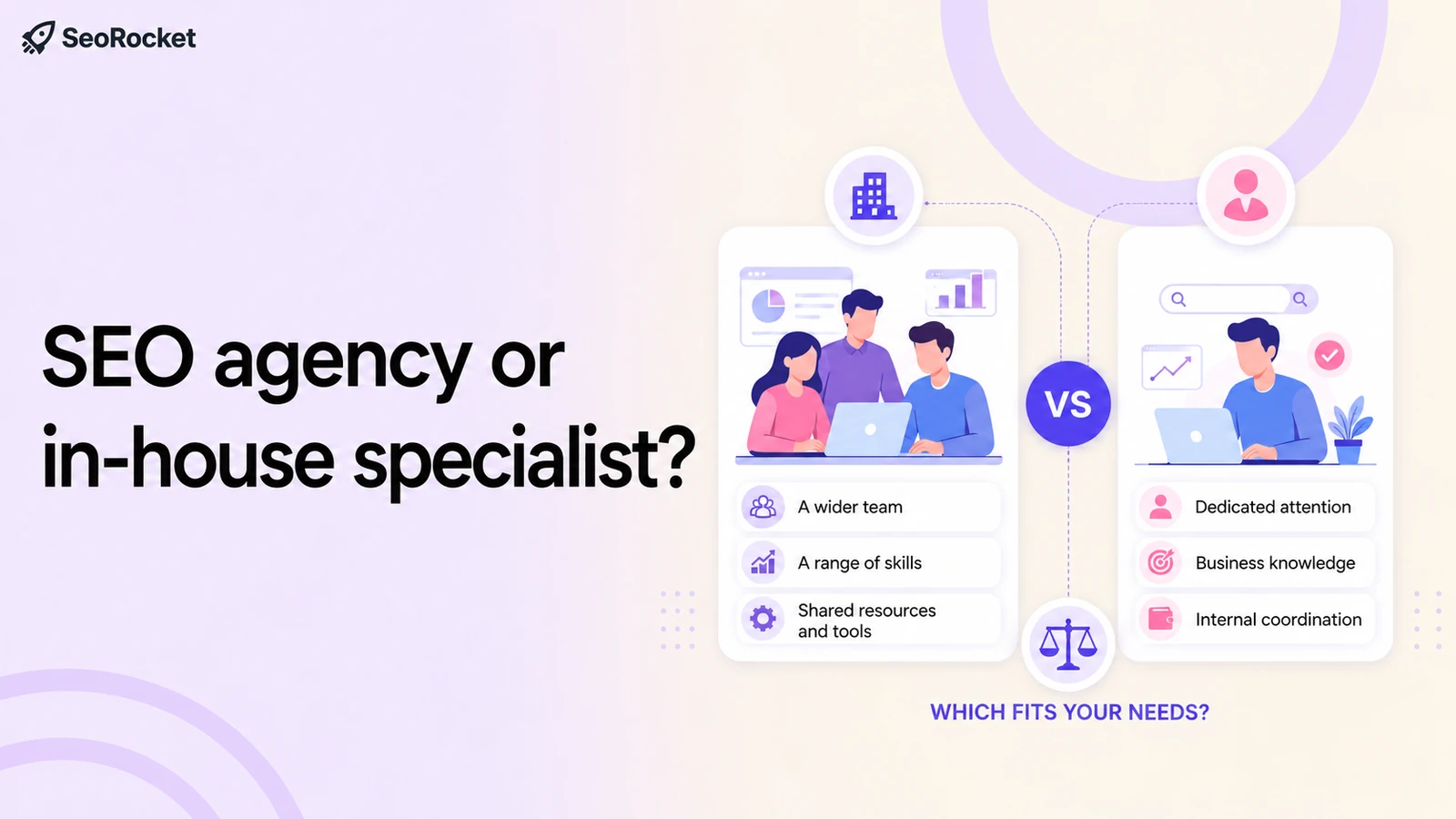
This article considers the advantages and limitations of each arrangement to help businesses choose an approach suited to their needs.
Why consider investing in SEO?
People frequently use search enginesto find information, products and services. If relevant demand exists for your offer, it is worth assessing investment in SEO servicesto improve your opportunity to appear in those results.
Search engine optimisation can improve relevant visibility and help address issues in content, usability and the website's technical foundation.
Why hire an SEO specialist?
If the marketing team lacks the time or skills to do this work, specialist support can help develop and implement a focused strategy.
What services do SEO specialists and agencies offer?
Backlink development
Identifying relevant opportunities for other sites to reference useful content, while avoiding manipulative link schemes.
Technical website analysis
Investigating and addressing technical issues that affect search access, indexing or website use.
On-page SEO
Improving page content, structure and other on-page elements to answer relevant searches more clearly.
Local SEO
Helping a business present accurate information and reach people searching in relevant locations.
Content and keyword research
Creating relevant content and carrying out researching search terms to reach target audience.
Monthly reporting and analysis
Monitoring performance, explaining the findings and refining the plan.
Should you hire in-house or work with an agency?
Once you understand the work required, decide whether it is better handled by an employee or an external team. The answer depends on the scope, resources and working relationship you need.
An in-house SEO specialist
What is an in-house SEO specialist?
An in-house SEO specialist is part of your team, often working full-time on the business's search performance. Responsibilities can include planning, allocating resources to SEO tools, researching competitors and coordinating with developers, sales and other marketing colleagues.
The specialist may manage several SEO projects and take responsibility for their progress, with support from the wider organisation.
4 advantages of an in-house SEO specialist
An employee can offer several practical advantages when the role and available support match the work required.
Dedicated focus
An in-house specialist focuses on your business rather than dividing time between external clients. This can make it easier to maintain attention on the company's priorities, although internal demands still need to be managed.
Knowledge of the business
As a team member, the specialist has regular access to the company's people and information.
Understanding the business's values, objectives and customers can help shape an SEO strategy that reflects its identity and priorities.
An external provider will need a deliberate onboarding and communication process to develop comparable understanding.
Internal relationships
Working alongside marketing, development and sales can make collaboration easier. An employee may build the informal relationships needed to get changes implemented across departments.
Visibility of the work
An in-house role can give managers and other stakeholders direct access to the person responsible for the work.
The team can review current projects and discuss changes as priorities develop.
3 challenges of an in-house SEO specialist
The arrangement also has limitations that should be considered before hiring.
Limited capacity
One person may be expected to manage too many tasks, objectives and specialist areas. If the scope exceeds their capacity, important work can be delayed.
Progress may also depend on how much development, writing and design support is available elsewhere in the organisation.
Employment costs
Recruitment takes time and money. Allow for salary, employment-related costs, training, tools and the support needed to do the job well.
You could hire several specialists to build a team, but that requires a larger commitment.
Dependence on one person
When knowledge and responsibility sit with one employee, absence or departure can disrupt the programme.
A gap in the person's skills may also require additional support. Documentation and access arrangements reduce the risk of relying on a single individual.
For example, someone may be strong in technical analysis and outreach but need help with content writing. Plan that support rather than expecting one role to cover every discipline equally well.
An SEO agency
What is an SEO agency?
An SEO agency is an external team providing search engine optimisation services to client businesses. Agencies differ in size, expertise, sector focus and the projects they take on.
They work with clients to plan and deliver SEO activity, with the responsibilities and scope defined in an agreement.
4 advantages of an SEO agency
Depending on the team and agreement, an agency can offer several advantages:
A range of skills
An agency may provide access to people with different skills, such as technical SEO, content and analysis. Check who will actually work on your account and what is included rather than assuming every discipline is covered.
A team can help manage work that would exceed one employee's capacity.
Experience across different projects can also provide useful comparisons and approaches.
Some agencies also offer paid advertising and other digital marketing services, which may be useful if the business needs coordinated support.
Shared learning and processes
An agency team can share research and practical experience as search technology changes. This is a capability to assess, rather than an automatic advantage over every in-house specialist.
Established processes can support delivery, although implementation speed still depends on the agreed scope, resources and the client's own approval or development capacity.
Ask how the team evaluates changes and turns relevant findings into work on your project.
A different cost structure
An agency avoids the need to recruit a full-time employee for work that may not require a full-time role. Whether it costs less overall depends on the scope and the support included.
The provider usually handles its own training and supplies its own SEO tools , though any separately billed software or services should be clear in the agreement.
Defined accountability
A clear agreement should identify who owns each task, how progress is reported and how problems are escalated.
A named contact helps coordinate decisions and resolve questions.
If the arrangement no longer fits, review the contract's notice period, data ownership and handover requirements before changing providers.
3 challenges of an SEO agency
An external arrangement also has limitations that may make an in-house role more suitable.
Distance from the business
Different locations or time zones can complicate meetings and urgent decisions. Agree availability and working arrangements in advance.
Location alone does not establish whether an agency is the right fit. Consider its expertise, communication and ability to work with your team, not just whether it can meet in person.
You will need a shared schedule and a communication rhythm that works for both sides.
One of several clients
Agencies normally serve more than one client. Ask how capacity is allocated and what level of attention the agreement provides.
Without a clear scope and priorities, your project may receive less attention than you expect.
A reliable provider should communicate delays and dependencies. An internal colleague may sometimes be easier to reach, but either arrangement needs clear response expectations.
Transparency and trust
Providers vary in quality and methods. A convincing sales presentation does not establish that the work is suitable or responsible.
Finding a partner takes time. You need enough evidence to understand what the agency will do and how it will report its work.
Review service descriptions, relevant projects and client feedback. Ask for concrete explanations of methods, access and reporting before signing.
Factors to consider when choosing an SEO partner
The following factors can help you compare an agency with an in-house hire:
SEO knowledge
Assess the person's or team's understanding, methods and approach to keeping skills current.
Relevant client feedback
Review evidence of previous work and how the outcomes were measured.
Skills
Check that the available technical, analytical and creative skills match the actual work.
Cost and scope
Compare the work, resources and responsibilities included in each option, rather than headline cost alone.
Customer support
Clear communication and a practical response to business needs matter in either arrangement.
SEO tools used
Ask what the tools are used to investigate and how their findings inform decisions. Tool ownership alone does not demonstrate expertise.
Is an in-house SEO specialist or an agency the better fit?
SEO services can support businesses that have relevant search demand. An in-house employee and an agency are two common ways to organise the work, and some businesses combine them.
An in-house role requires employment resources but provides a dedicated person within the organisation.
An agency provides external support within an agreed scope, potentially drawing on several specialist skills.
Either can be effective. Choose according to your objectives, internal capability, implementation needs and budget, and establish how progress will be assessed.