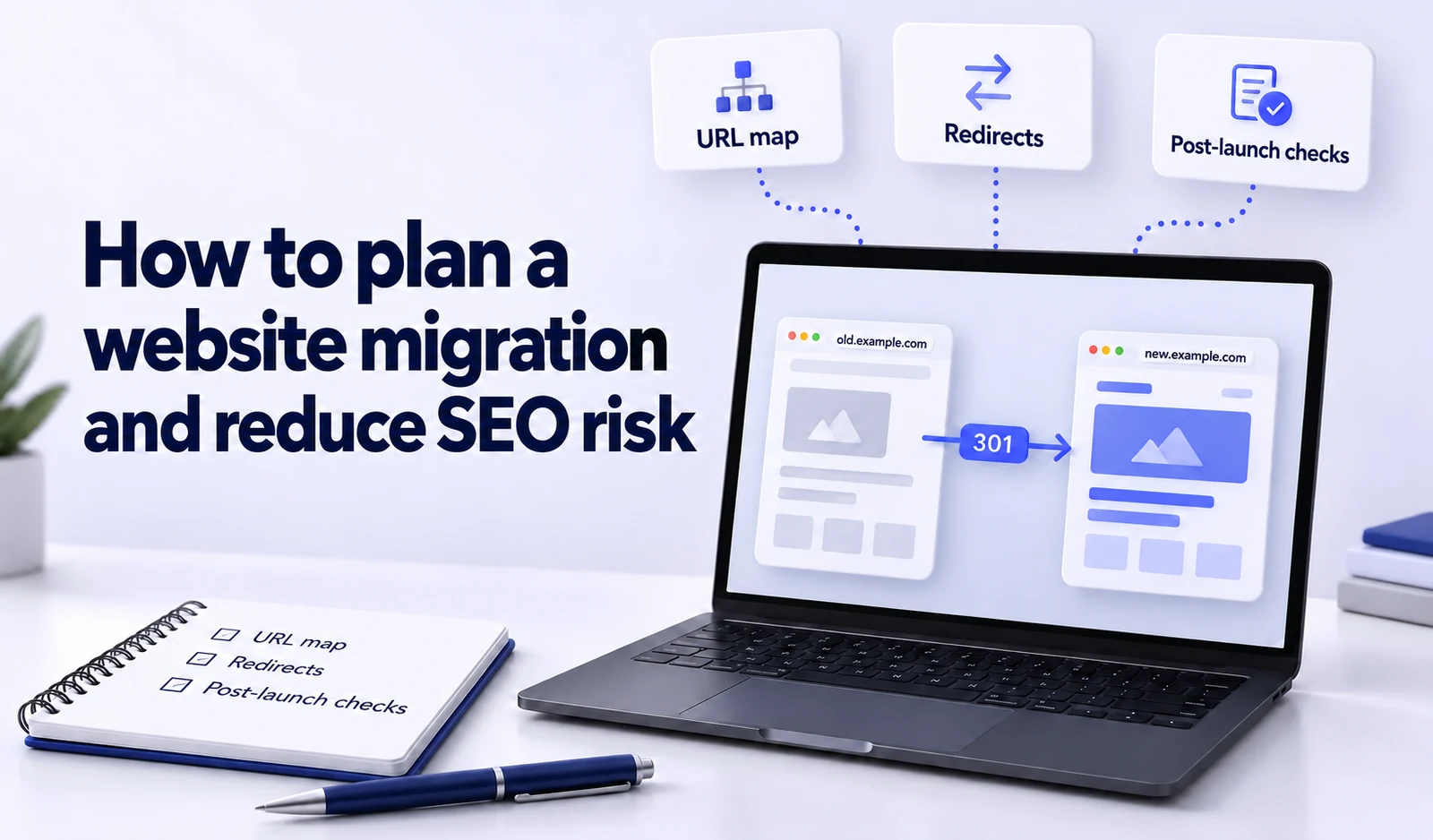
A domain name gives a website a recognisable address. People can enter it in a browser instead of remembering the server's numerical IP address.
Like a street address, it needs to be easy to recognise and share.
Choose a name that fits the brand and distinguishes the business. Its main value is in recognition and usability, rather than guaranteeing better rankings. SEO advice can help you consider the implications of a new domain or a future move.
The parts of a domain name
A simple domain name commonly contains two parts:
Top-level domain
The ending, such as .lt, .com, .org or .net.
Second-level domain
The name directly before that ending, which identifies the registered domain.
A clear, memorable name can make the website easier to find again and share with others.
Why domain choice matters
Domain choice affects how people recognise and use the address. It is one part of website planning, rather than a substitute for good content or technical work.
A shorter, memorable domain can be easier to type or pass on.
When the name reflects the business or subject, people may understand what to expect from the URL before opening it.
A clear name can also reduce typing mistakes and confusion. These practical advantages should not be presented as an automatic search-ranking benefit.
Many domain names can support a successful website with appropriate SEO servicesand useful content. A considered name helps avoid future branding or migration difficulties.
Choosing a domain for your website
Choosing a domain with SEO in mind means considering the audience, the site's purpose and long-term practicality, without chasing a keyword formula.
The following seven guidelines can help.
1. Choose an extension suited to the audience
Start with an extension that suits the audience and the site's purpose. Examples include:
- .lt
- .com
- .org
- .edu
- .gov
- .net
- .ca
- .ai
- .store
- .io
- and others
Consider where the audience is based, what it will recognise and any registration restrictions.
A country-code extension such as .lt can suit a Lithuanian business, while .uk may suit an appropriate UK audience. Generic endings such as .com or .net can work internationally. There is no requirement to use them for every international project.
An organisation may choose .org because it suits its identity, but that ending does not prove non-profit status. Restricted extensions such as .edu and .gov are not ordinary branding options available to every educational or public-facing business. Check the registry's eligibility rules.
2. Consider relevant wording
A relevant word may make the subject clear, but a keyword is not required in the domain. A recognisable brand is usually a better foundation than a string of search terms.
For example, the Lithuanian name “Veterinaro Paslaugos Vilniuje” describes veterinary services in Vilnius. Descriptive wording can explain an offer, though it may be less distinctive as a brand.
An illustrative name such as petgroomingpros.com also makes its subject apparent; this is not a recommendation or availability check.
Keyword research can show how customers describe a service. Use that insight when considering a name, but do not assume that the most searched phrase is the best domain.
If you include descriptive wording, keep it clear and memorable. A location can help communicate the service area, but consider whether it would limit future expansion.
3. Keep the name manageable
Short names are often easier to type and remember. “No more than three words” can be a practical preference, not an SEO rule. Numbers and hyphens are technically valid but may make a name harder to communicate.
A simple name helps people recognise the address and return to it.
Choose wording that reflects the website or business and makes sense to the intended audience.
For a Lithuanian gardening site, “Sodininkyste” or “Sodininkystespatarimai” may communicate the subject more clearly than a generic label such as “svetaine1000”. These are examples, not available-domain recommendations.
Balance clarity with distinctiveness. A name alone does not create search traffic.
4. Avoid unnecessary numbers and hyphens
Adding numbers or hyphens can distinguish a string, but can also make it harder to remember or enter accurately.
For example, a name such as “sodinimo-paslaugos-15” asks people to remember punctuation and a number as well as the words.
A short name without unnecessary characters may be easier to use, though the best choice depends on the actual brand.
5. Make it easy to say and spell
Say the proposed name aloud. If pronunciation is uncertain, people may find it harder to remember or recommend.
Also ask someone to write it after hearing it. Ambiguous spelling can lead to errors or visits to a different address.
6. Allow for future business changes
Consider whether the business may expand beyond its current niche or area.
Avoid wording that would become misleading if the product range or service area changes.
7. Register with a suitable provider
After selecting a suitable name, check availability and the registration terms.
Registration gives you the right to use the domain under the registry and registrar's terms for the registration period. It does not guarantee permanent ownership or eliminate trademark disputes. Choose a provider with suitable account security, support and renewal arrangements.
Compare the initial and renewal prices, transfer terms and any additional services. Keep contact and payment details current so an avoidable lapse does not interrupt the website.