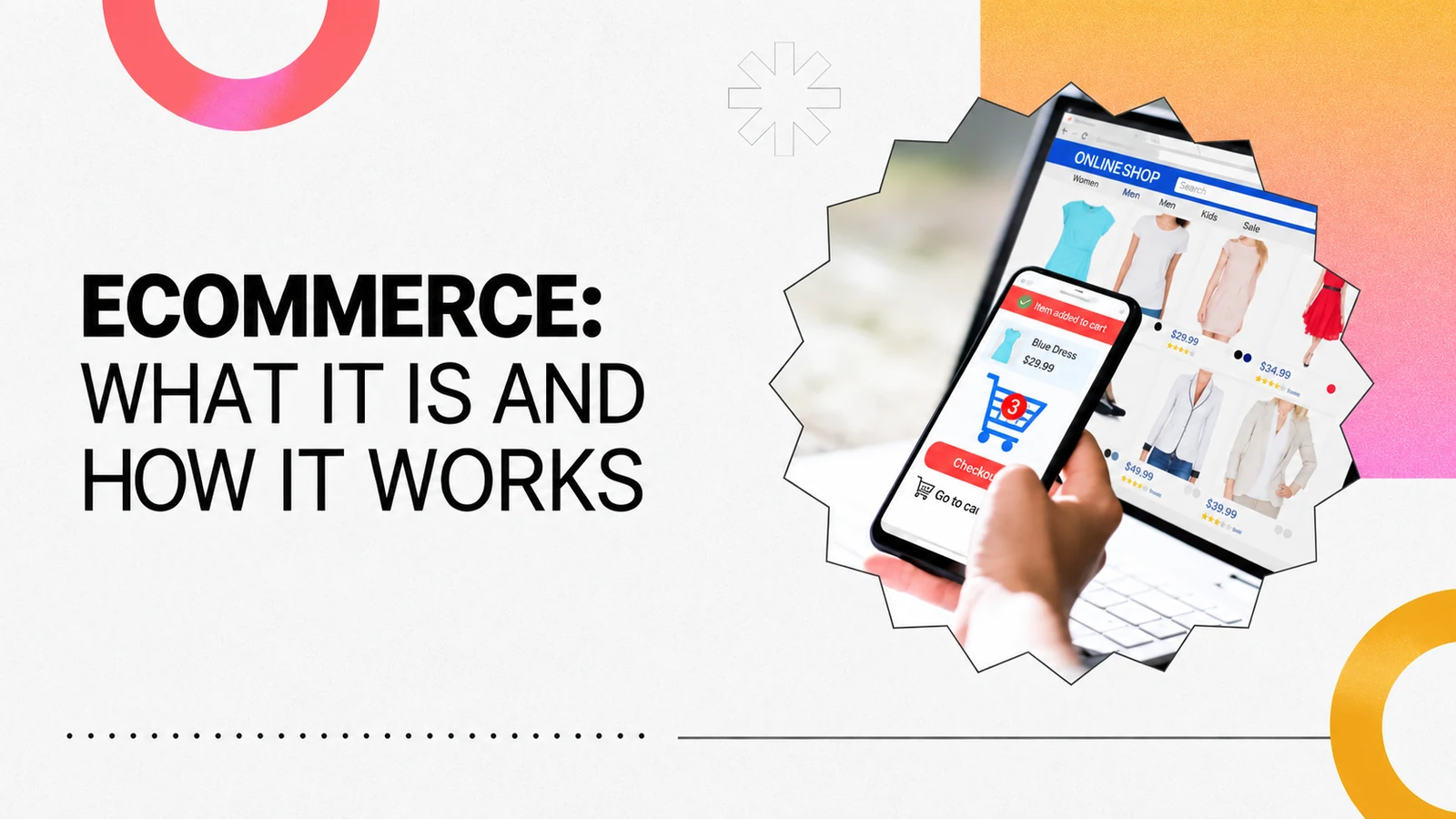
Ecommerce means ordering goods or services through electronic networks, usually the internet. Payment and fulfilment may involve separate systems. Common transaction relationships include business-to-business (B2B), business-to-consumer (B2C), consumer-to-consumer and consumer-to-business.
Ecommerce and e-business are related but not identical. E-business can describe broader digitally supported operations, while online retail refers more specifically to selling goods to consumers through digital channels.
Platforms such as Amazon and eBay helped make online transactions familiar to many customers. When discussing market growth, use a dated source with a defined country, category and denominator; a retail percentage from one market should not be presented as a global ecommerce share.
How does ecommerce work?
A customer uses a website or app to inspect an offer and submit an order. The business then needs a reliable way to handle availability, payment, confirmation and delivery or access.
The technical flow varies. A store may exchange information with inventory, order-management and payment systems. A payment provider can authorise or process a transaction without the shop itself storing all card details. Do not assume that every order passes through a single central computer in the same sequence.
After the relevant checks, the system confirms the order and initiates the agreed fulfilment process. The distinction between receiving an order, authorising payment and accepting a contract should reflect the store's actual workflow and terms.
Fulfilment may mean shipping a physical item, delivering a download or granting access to a service, depending on what was purchased.
Where do online transactions take place?
A business can use a marketplace, a hosted commerce platform or software it operates itself. The choice changes responsibilities for infrastructure, customisation and maintenance. Open-source software may be maintained by in-house developers.
Types of ecommerce relationship
The following labels describe different relationships and approaches; they are not all mutually exclusive categories.
Business-to-business (B2B)
Companies sell to other companies. Online ordering may involve trade pricing, negotiated terms, approvals or procurement integrations, according to the offer and customer.
Business-to-consumer (B2C)
A company sells to an individual consumer for personal use. Delivery, payment and support can involve partners, while responsibilities need to be clear to the customer.
Online retailers and marketplaces offer many consumer products. A marketplace can include both business and private sellers, so classify the actual transaction rather than assuming every sale on a platform has the same model.
Direct-to-consumer (D2C)
A brand or producer sells directly to the consumer rather than relying on an independent retailer. D2C is usually a form of B2C, not its opposite. Payment or fulfilment partners may still participate.
Consumer-to-consumer (C2C)
Individuals transact with one another, often through a third-party marketplace. The platform's commercial relationship with users is separate from the relationship between buyer and seller.
Classified and resale platforms can support C2C transactions. Examples include private listings on eBay, Facebook Marketplace or Depop, while professional sellers may also use some of these services. Check the seller and terms of the particular offer.
Consumer-to-business (C2B)
An individual supplies something of value to a business, such as licensed creative work or an agreed service. The label depends on the actual role and contractual relationship, not simply the website used.
A creator licensing a photograph for commercial use can illustrate the idea. “Royalty-free” does not mean free of copyright or licence conditions. A job-listing website alone does not establish that every resulting employment relationship is an ecommerce sale.
Business-to-administration (B2A)
This term can describe electronic dealings between businesses and public bodies, including procurement. Broader interactions such as submitting records are digital administration, but are not necessarily purchases or ecommerce in the narrow sense.
Consumer-to-administration (C2A)
Individuals may interact with public bodies online. These activities can include services and payments, but not every exchange is commercial. Examples include:
- Social insurance — submitting information or receiving eligible payments.
- Tax — filing a return or making a payment through an official service.
- Health services — appointments, authorised information access or relevant payments, with appropriate handling of sensitive information.
Mobile commerce
Mobile commerce describes online transactions using devices such as phones or tablets. An app, mobile website or conversational interface may support a purchase, but not every chatbot can complete a transaction or payment.
Potential advantages
Availability beyond store hours
An online shop can accept orders outside normal staff hours, subject to availability and maintenance. Customer support and fulfilment may still have defined operating times. Physical retailers also have varied opening schedules rather than a universal weekend closure.
Convenient access
Customers can browse without travelling to a shop. The experience depends on the connection, device, site design and checkout; there is no universal five-minute purchase time or guarantee that every page loads within seconds.
A wider accessible catalogue
An online catalogue can present more items than a small display area, with fulfilment from suitable locations. Accurate availability and delivery information remain essential; a large catalogue is not useful if the offer cannot be fulfilled.
Access to product information
Search, categories and filters can help people compare products and find details. Their usefulness depends on accurate data and a workable interface, not simply the presence of a search box.
Reaching additional markets
Online selling can extend reach beyond a physical location. Cross-border trade still involves delivery, language, payment, tax and other obligations, so internet access alone does not mean the business can serve every country.
A different cost structure
An online-only model may avoid some retail-premises expenses, while still requiring technology, marketing, support, storage and fulfilment. Compare the complete cost rather than assuming ecommerce is always cheaper.
Relevant product recommendations
A store may use appropriate information to offer related products or assist navigation. Collect and use customer data on a valid basis, explain relevant practices and avoid assuming that every visitor can be tracked without restrictions.
Limitations and responsibilities
Customer support limitations
Online customers may not have an immediate person to ask. State support hours and channels clearly, and provide a route for questions that automated assistance cannot resolve.
Limited hands-on evaluation
Photos and specifications cannot reproduce every physical experience, such as trying on clothing or testing an instrument. Provide accurate descriptions and applicable return information. Preview technologies may help with some decisions, but do not remove the need for clear terms or consumer protections.
Delivery time
Physical items generally need fulfilment after ordering. Available speeds vary by stock, location and service; same-day delivery should not be assumed. Digital access has different delivery considerations.
Security risks
Fraudulent shops can imitate legitimate businesses, while genuine stores can also suffer security failures. Secure payment handling, access controls and provider arrangements matter. Card-on-file features may use provider tokens rather than storing the full details in the shop, so assess the actual architecture instead of assuming all saved cards are held locally.
Systems and processes behind ecommerce
Ecommerce operations can involve catalogues, baskets, order systems, payment interfaces, mobile apps and business-data integrations. A file-transfer protocol is a technical transport option, not a marketing strategy in itself; sensitive transfers need an appropriate secure method.
Communication may include requested order updates and appropriately authorised marketing. Keep those purposes clear. Email, SMS, social posts or coupons each have their own audience expectations and controls; changing the channel does not remove responsibility for appropriate data use.
Security is an ongoing operational responsibility
Plan how customer information is collected, accessed, retained and protected. Define which responsibilities belong to the business, software operator, payment provider and other suppliers rather than assuming one integration covers every risk.
Build relevant controls into the design and maintain them after launch. Updates, access reviews, monitoring and tested backups are part of operating the service, not a one-time launch task.