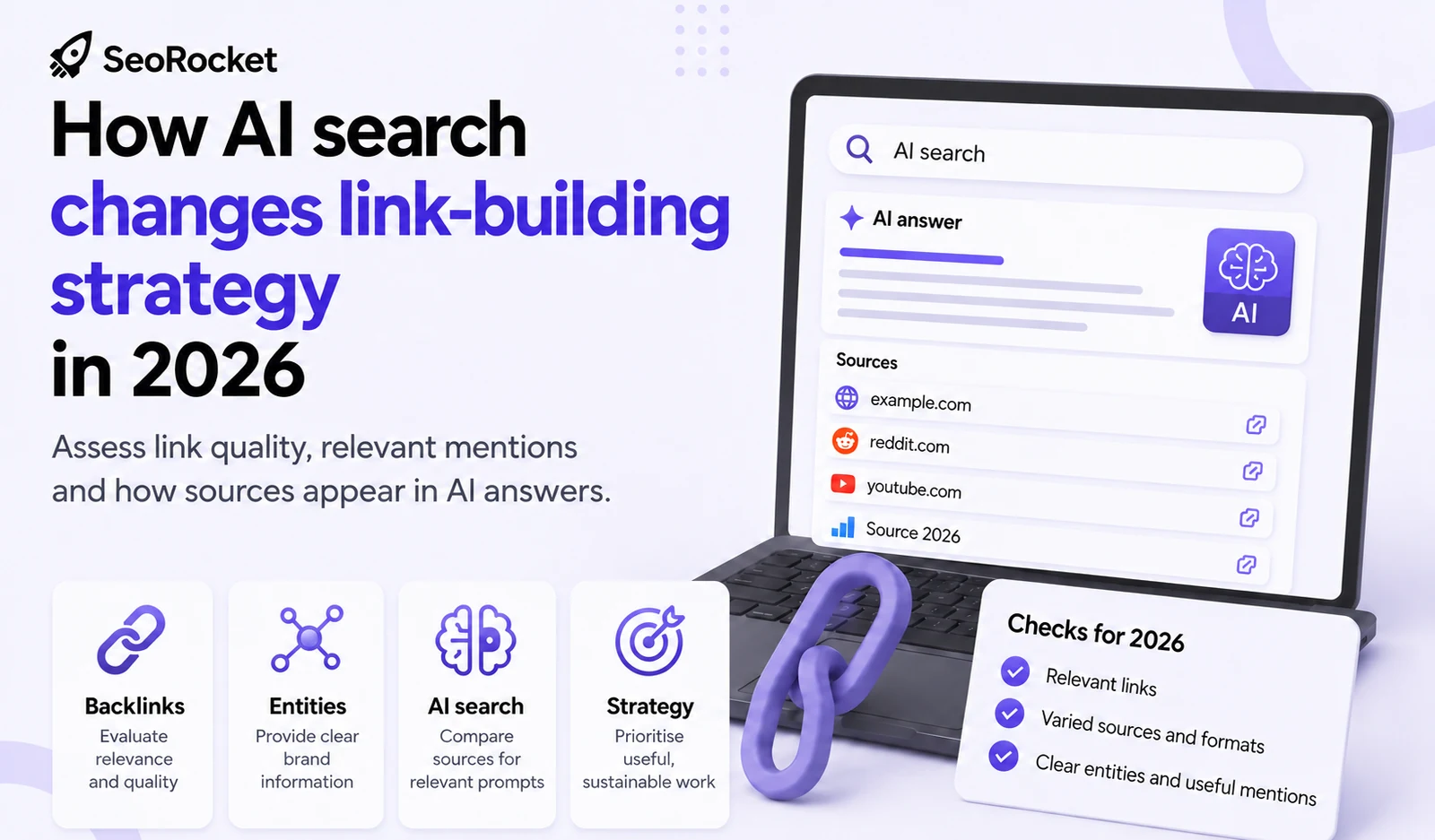
AI search adds new ways for people to discover sources and brands. This article examines why backlinks still matter, how entity-based SEO can inform the work, and which practical principles remain useful in 2026.
Backlinks have been discussed in SEO for many years. When assessing search-interest data , check the source, period and methodology before treating a rising trend as evidence that a technique works.
AI-generated answers and searches that end without a website visit create new measurement questions. Marketers need to distinguish links, unlinked brand mentions, citations in an answer and actual referral traffic. These are related observations, but they are not interchangeable measures of authority or commercial value.
A platform can mention a brand without linking to its website. That demonstrates that a mention and a backlink are different outputs; it does not reveal the platform’s complete ranking method or prove that unlinked mentions carry a particular weight.
Backlinks have not become irrelevant. Their contribution should be evaluated alongside relevance, discovery, useful referral visits and the broader reputation of the business.
The following principles help SEO specialists review link work without assuming that an AI citation proves a particular ranking mechanism.
What has not changed about links
Relevant editorial references remain a useful part of an SEO strategy . Assess the referring page, its audience, the reason for the link and the destination it supports.
When reviewing industry surveys, distinguish marketers’ opinions from measured effects. A respondent’s belief about rankings does not establish a causal relationship.
How backlinks can support search visibility
Planning should account for editorial work, original research and outreach. A published placement price does not establish a link’s value, and buying links to manipulate rankings can breach Google’s spam policies. Compare the work and its relevance rather than use a generic price as a quality benchmark.
Google’s ranking systems use link analysis among other signals. This supports considering links in an SEO strategy, but it does not mean that every additional link improves a page’s position.
A correlation between links and leading search results would not, by itself, show whether links caused those rankings. Strong pages and recognised businesses may attract links for other reasons.
The AI search context
SEO methods have evolved with search. AI-generated answers add a reason to review where information is published and how references are measured, while retaining sound technical and editorial practices.
Practitioners sometimes describe work on answer visibility as AEO, or answer engine optimisation. It overlaps with established SEO, but industry opinions do not establish a universal formula for inclusion in an AI answer.
Interest in answer visibility is a reason to investigate it, not proof that a new label requires an entirely separate optimisation system. Google states that its existing SEO guidance applies to its AI search features.
Answer engine optimisation
Unlinked mentions in places such asRedditandYouTubecan expose people to a brand or provide information that a system may retrieve. Their value cannot be assumed to equal that of an editorial backlink.
AI systems differ in their training, retrieval and answer-generation methods. Some can use retrieved discussions, reviews, transcripts and other material. Their access and selection vary, so a brand mention on an available page is not a guarantee of citation.
Maintain accurate, consistent information where your business is genuinely represented. Do not manufacture discussions or reviews in an attempt to produce a desired answer.
Practical priorities for backlinks
The practical principles below focus on relevance, editorial value and clear measurement rather than unsupported predictions about platform weights.
- Source variety can be useful when it results from genuinely different relevant audiences discovering your work. Do not pursue diversity as a numerical target or assume that search engines automatically reward a particular distribution of referring domains.
- Assess quality in context. A useful link has an intelligible editorial reason, appears on a credible relevant page and leads to information that serves the reader. When considering industry research , examine its sample, query set, platform versions and dates. A statistical association between a third-party authority score and AI mentions does not prove that the platform uses that score.
- Nofollow links may bring relevant visitors, awareness and discovery. Google treats link attributes as hints in the applicable contexts; there is no basis for promising that nofollow and ordinary links have equal ranking or AI-citation effects.
- An image can also link to a source. Use meaningful alternative text and a relevant destination where a linked image serves the reader. Do not treat an image backlink as a special shortcut to inclusion in ChatGPT, Gemini or Perplexity.
Connecting link strategy with entity SEO
Entity SEO provides a way to think about how a business, its people, products and subjects are represented and connected. It complements a page-and-link review rather than replacing it.
Review what the business is known for, which reliable sources describe it and whether its public information is consistent. These checks can improve clarity for readers and systems without implying a confirmed formula for AI authority.
Interest in entity SEO should be separated from evidence about its effects. Define the specific action and the measurable outcome before judging whether an approach is useful.
Entity SEO
An unlinked Reddit discussion and an editorial link from a website can serve different audiences and purposes. A third-party domain authority score does not provide a reliable exchange rate between them.
For a discussion platform, inspect the relevant conversations and whether people actually use them to compare options. Broad citation percentages from a research sample should not be treated as universal market shares or reasons to post promotional comments.
Evaluating discussion sources by query intent
A sound publishing and distribution plan starts with material that deserves attention: clear expertise, useful evidence and something relevant to the audience of the publisher.
Original research, transparent surveys and practical resources can give publishers a reason to reference a business. Explain methods, limitations and sources so that the work can be assessed. Citations, referral visits and commercial outcomes should then be measured separately.
Connect link work with the subjects where the business has credible knowledge. Earn useful references, keep public facts accurate and assess visibility across relevant searches over time. None of these steps guarantees a ranking or an AI citation.