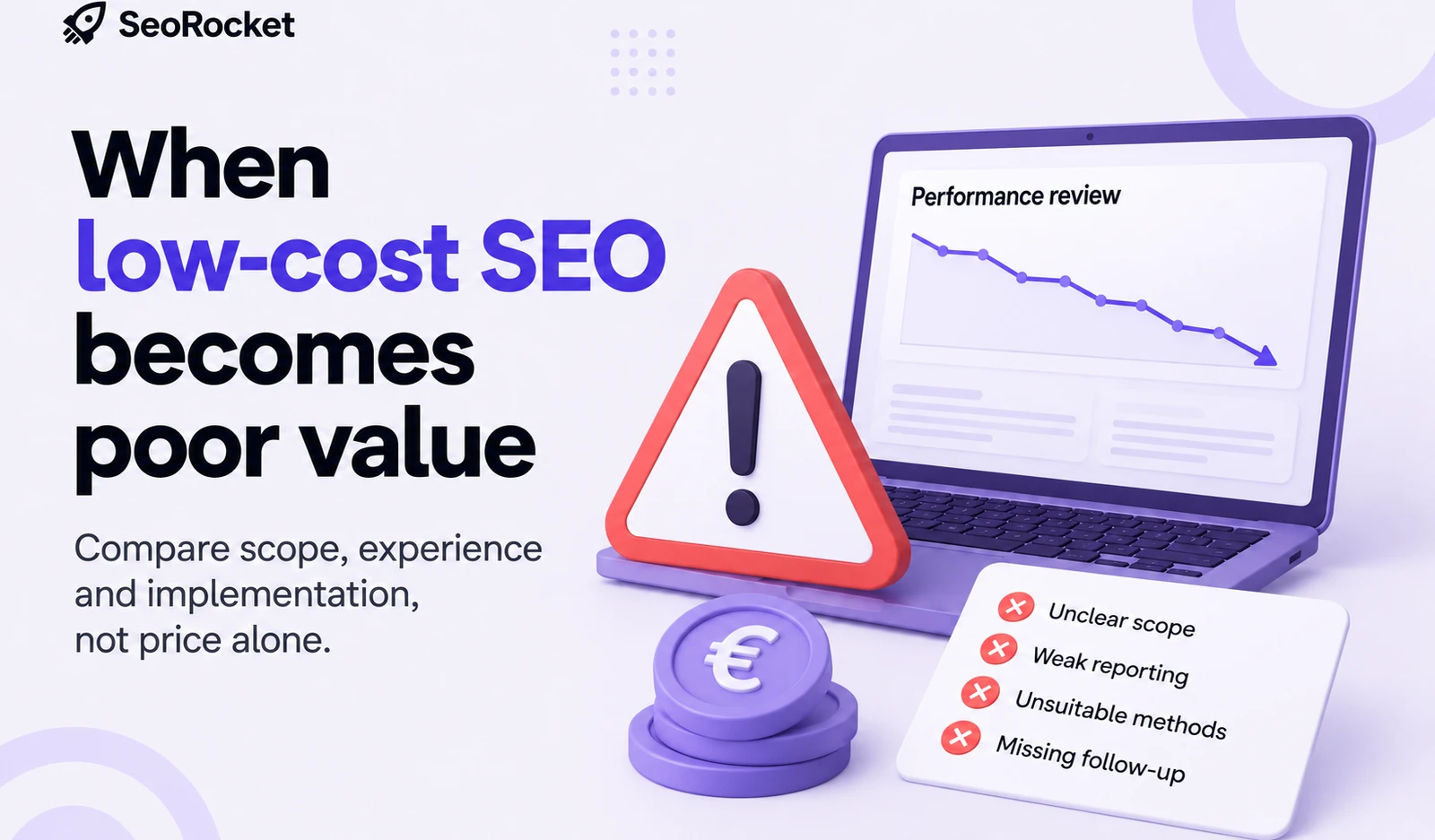
A very low-priced SEO services offer deserves careful examination when it promises extensive work or guaranteed results. Price alone does not establish quality, but an unclear scope can leave important work undone.
This guide examines the risks behind poorly scoped services and the alternatives available to businesses with limited budgets. A modest, clearly defined engagement can be valuable; an unrealistic promise at any price is a different matter.
What counts as cheap SEO?
There is no universal definition of cheap SEO. Affordability depends on the business, the work required and the resources available.
For illustration, a €2,000 monthly engagement may be manageable for one business and unaffordable for another. That figure is an example, not a market benchmark.
“Low cost” can describe a limited scope or an efficient delivery model. It should not automatically be treated as a synonym for poor quality.
Assess the proposed work, expertise, methods and reporting alongside the fee. These determine whether an offer provides useful value.
The business needs competent, accountable support within a realistic scope.
Choosing solely by the lowest headline price can hide trade-offs. Ask what is excluded, how priorities are chosen and which methods will be used.
Poor implementation or manipulative tactics can harm visibility and create recovery work, regardless of the provider’s price.
When can a low-cost service cause harm?
Many providers promote affordable packages. The relevant question is whether their commitments are achievable and useful for your website.
Compare the promised deliverables with the time and skills needed to complete them. Be cautious when an offer guarantees outcomes the provider cannot control.
Similar package names can hide very different work. Request concrete descriptions rather than assuming every low-cost provider operates in the same way.
The following checks help expose potential weaknesses before a contract is signed.
Five risks to investigate before buying
Investigate these five risks:
- a standard plan that ignores the business’s needs;
- unclear or inadequate communication;
- insufficient expertise or supervision;
- methods that violate search policies;
- little useful work retained by the business.
1. A copied plan with no relevant priorities
A constrained budget should lead to a narrower, prioritised scope. Ask the SEO agency or freelancer how the proposed work responds to your actual situation.
A generic checklist can miss the problem that matters most. Reporting completed tasks is not the same as showing relevant progress.
The provider should understand the business model, products, audience, market and main competitors sufficiently to set priorities.
If every client receives the same work, establish whether those tasks are genuinely relevant to your website.
Reusable processes can improve quality, but the decisions within them still need to fit the project.
A cleaning company and an online shop may differ in audience behaviour, competition, query intent, buying cycle, site structure and content requirements.
Ask how the provider changes direction when evidence shows a task is not useful. A monthly checklist should not replace that decision.
Because some outcomes take time to assess, require interim evidence of the work and a clear reason for each priority.
An unusually broad promise at a very low fee needs an explanation of how the work will be resourced.
Standard procedures are not a problem by themselves. The concern is applying them without checking the website or business need.
A defensible proposal explains the starting situation, the work selected and the assumptions behind its cost.
The plan should reflect the brand, internal team, genuine strengths and commercial goals.
Ask the provider which differences between your business and another client would change its recommendations.
2. Communication that the contract does not define
Check who owns the relationship and how questions, approvals and urgent issues will be handled.
Different working hours or languages can require planning, but they do not establish service quality. Agree practical arrangements with the actual team.
Communication failures can undermine an otherwise useful engagement at any price.
Confirm how to reach the responsible person and when reporting or strategy discussions take place.
The agreement should explain what support is included and how unanswered or urgent issues are escalated.
Agree the working language and suitable meeting times.

If subcontractors are involved, ask who supervises their work and how responsibilities remain clear. Their country of residence is not a quality test.
Choose arrangements that allow necessary decisions without repeatedly disrupting either team’s working day.
Use written briefs and decision records where they reduce misunderstanding.
The contact should know enough about the project to explain priorities or obtain a reliable answer from the specialist responsible.
A contact who can only repeat a task list may not provide the coordination the business needs.
Include your own management time when comparing offers. A lower invoice can still require more internal coordination.
Clear ownership and reporting help the marketing team explain decisions to business leaders.
Compare the overall cost and usefulness of the relationship, not the fee in isolation.
3. Expertise that does not match the work
Ask who will perform specialist tasks and how less experienced staff are supervised.
A project contact does not need to know everything, but the team needs access to the competence required by the scope.
Weak diagnosis can lead to effort being spent on the wrong problem.
A standard process does not remove the need to hire experienced specialists for complex decisions. Confirm who reviews technical and strategic recommendations.
Request a relevant example of the team’s reasoning and implementation rather than relying on job titles alone.
For a small budget, a limited set of well-chosen tasks may be more realistic than an extensive campaign.
An experienced SEO specialist needs enough allocated time to investigate and explain the work. The proposal should account for that time.

Do not assume that skilled people avoid every low-cost provider. Assess the actual team, review process and capacity.
The relevant risk is insufficient expertise for the agreed responsibility.
For example, manipulative link schemes may appear to offer quick progress while exposing the website to search-policy consequences.
Ask how proposed methods are checked against current guidance.
A limited budget may also be used to train the internal team instead of outsourcing every task.
With suitable knowledge and support, staff can handle routine improvements and recognise when specialist assistance is needed.
4. Manipulative or outdated methods
Check the methods independently of the price. Ask the provider to explain significant changes and placements.
An old tactic is not automatically wrong, but it needs a current justification and should comply with applicable search policies.
Be especially cautious when a proposal substitutes manipulative shortcuts for relevant work.
These can include deceptive content or links intended primarily to manipulate ranking systems.
The policies of search engines such as Google describe prohibited practices. Review those policies instead of accepting a claim that a tactic is safe because many providers use it.
Assess proposed black-hat methods against the actual search policy and the potential consequences, rather than accepting a marketing label.
Ask for a clear explanation of the method before approving the work.
Ask what evidence supports the approach and what happens if it causes an issue. A provider’s confidence does not remove the business’s exposure.
Search-policy violations can have consequences for visibility.
A manual action can affect some or all of a site’s search appearance. Investigate the stated issue rather than assuming every traffic decline is a penalty.
An online shop that depends on organic traffic may experience commercial harm if important products become harder to find.
That is why implementation quality and risk controls should be part of the buying decision.
The service fee may be only a small part of the cost if recovery work becomes necessary.
Include the potential impact on the business when evaluating an apparently inexpensive shortcut.
A responsible engagement should help the business make informed decisions about those risks.
5. Work that leaves little lasting value
Ask what useful assets and improvements the business will retain.
For example, a relevant backlinks profile can support discovery, but it should be assessed alongside the content and technical work rather than treated as a guaranteed ranking asset.
The proposal should explain which work is included and which resources it requires.
Useful long-term work includes accurate content, accessible architecture, reliable measurement and well-documented implementation.
Original resources may also earn appropriate references from other websites.
Content should serve the intended reader and be maintainable after the engagement.
A page that explains a problem well or contributes reliable evidence gives others a reason to reference it. Links are not automatic.
Evaluate external references for relevance and editorial value rather than volume alone.
Check whether the agreed budget can realistically support the proposed work.
If not, narrow the scope instead of expecting the provider to deliver an implausibly large campaign.
Useful content requires knowledge of the business, products, audience and market.
A reusable template can organise the work, but it cannot supply that knowledge by itself.
Use these questions to compare offers on evidence.
There is little value in paying for irrelevant tasks or methods that expose the site to avoidable risk.
Training, a focused audit or a small implementation project may be a better use of the same budget.
Look beyond the sales pitch
A provider can remain visible in the market through effective sales activity even when the proposed service is not suitable for your needs.
Assess the sales process separately from the quality of delivery.
Be cautious about unsolicited pitches that rely on fear, claim access to information the provider cannot have or promise guaranteed rankings.
An affordable offer is not itself suspicious. The question is whether its claims, scope and terms withstand scrutiny.
Ask how the provider reports work, retains knowledge and handles the end of a contract.
SEO often requires ongoing maintenance, but that does not justify an unclear long-term commitment.
Read the term, cancellation process, ownership and access clauses before signing.
A constructive relationship provides clear responsibilities and enough business context to make useful decisions.
What makes an SEO budget realistic?
At SeoRocket, monthly starting budgets are €400, €600 and €800 + VAT, with scope prepared individually.
Our rate is €50 + VAT per hour. The agreed project budget can cover specialist work, content, development and external SEO as required by the individual plan; it is not a universal promise of identical deliverables.
A larger or more complex site may need a different allocation. Compare the agreed priorities and resources rather than treating these starting figures as a market average.
Ask each provider to explain the hours, work and external costs behind its proposal. A lower price can reflect narrower scope; a higher one still needs justification.
If the proposed SEO pricing exceeds the budget, there are alternatives to buying an unrealistic package.
What can a business do with a limited SEO budget?
Available resources vary with the business’s size, revenue and priorities.
A limited budget calls for a narrower plan, not lower standards for accuracy or safety.
Choose work that can reasonably contribute to the SEO goals within the resources available.
Options include:
- training the internal team;
- buying a defined number of consulting hours;
- building a clearer internal business case;
- implementing selected work in-house.
Invest in useful training
Basic knowledge helps a business evaluate recommendations even when an agency performs the work.
It can also let staff handle routine improvements and recognise work beyond their competence.
Start with suitable free documentation before committing to courses or events.
Structured training can help when the team needs a coherent learning path and practical feedback.
Useful starting points include:
Use primary documentation to confirm platform requirements and review the dates and evidence behind third-party advice.
Use a focused consultation
A consultant can investigate a specific question, review priorities or help an internal team choose the next step.
Agree the paid time, required access and expected output in advance.
SeoRocket’s current rate is €50 + VAT per hour; other providers set their own terms.
Clarify whether implementation is included or will be handled by the internal team.
Some recommendations may need input from website development or developers.
For example, a review may identify missing business details that should be available to visitors.
It may also recommend navigation changes that help people find the right information.
Set an initial time allowance and a process for approving additional work.
This makes the cost easier to control and avoids an open-ended consultation.
Build an internal business case
Where investment is limited, explain the business problem and the evidence behind the proposed work.
A clearer case may help leadership choose priorities, although a larger budget is not the only possible outcome.
Useful resources can include:
- an SEO introduction for business leaders;
- a practical guide to explaining an SEO investment;
- material on presenting search opportunities to senior management.
Choose a discussion or presentation suited to the decision being requested.
Explain the expected work, costs, dependencies and measurement limits.
Address genuine concerns instead of promising a guaranteed return or dismissing other business priorities.
Begin with a manageable in-house plan
An internal team can start with selected tasks when it has the time and competence to maintain them.
Use the business’s knowledge to prioritise a small number of useful improvements, and obtain specialist help for uncertain decisions.
Allocate funds to the resources that remove the actual bottleneck.
That might mean a writer who can develop accurate, well-briefed content.
Or it might mean design or development work needed to make information usable.
Document the work and outcomes to inform the next planning cycle.
If additional resources become available, reconsider which responsibilities are best handled internally and which need external support.