If you want to improve your website's Google Search visibility, begin with the audience, the current results and the website's actual constraints.
This guide explains a practical approach to those foundations, rather than claiming a single method has produced a particular ranking.
The same principles can be applied to different topics, provided the content answers the relevant need.
Other discovery platforms may also use web content, but their systems and requirements differ. A Google Search improvement does not guarantee a result in every AI assistant.
Consider visibility across relevant experiences: AI Overviews, organic listings and other applicable search or conversational interfaces.
SEO needs to account for that wider context.
Tracking only a single search engine's positions can miss other sources of discovery or changes in presentation.
Assess how information appears and what people do next, alongside the position of an individual link.
Search platforms and AI features can:
-
Use relevant information from passages within pages
-
Answer some questions before a website visit
-
Present information about organisations without every reference including a backlink
The following practices can make information more accessible and useful. They cannot ensure inclusion across all AI systems.
First distinguish conventional rankings from the ways results may be presented.
How search results and AI features present information
Search systems rank pages and may also extract information or construct answers from supporting sources.
For a particular query, a system may:
-
Interpret the task behind the wording
-
Find relevant pages and passages
-
Present suitable information through links or supported result features
The mix varies by query. An AI answer, featured snippet and carousel are different presentations, not interchangeable outputs from one fixed process.
Understanding these distinctions helps avoid unsupported optimisation rules.
Relevant passages within useful pages
Google can use passages to understand how a page answers a question. This does not mean it has stopped ranking pages or that every paragraph competes independently of its surrounding content.
For a cost question, a clear paragraph explaining price, scope and conditions may provide useful information.
Keep the overall purpose coherent and make individual explanations clear enough to understand in context.
Concise answers can also be useful in conventional search presentations. No particular paragraph format guarantees extraction.
Answers using language models
Google's AI features may find supporting pages through related searches across subtopics. A clear structure can help readers understand a source, but is not a formula for selection.
Supporting links may differ from those in a single conventional result set. Inclusion requires meeting the relevant technical and policy conditions; a low or high position for one query does not settle every other search.
Assess the content and the actual result, rather than assuming a simple relationship between rank and citation.
Brand mentions without links
An organisation can be discussed in text that large language models may encounter. The fact of a mention does not prove it caused a later recommendation or citation.
Forums and discussions may be useful sources for particular questions. Do not manufacture mentions or assume that posting a brand name in a thread will influence an AI answer.
Practical foundations for Google Search visibility
Establish the SEO foundations
Google states that established SEO practices remain relevant to AI features.
Useful content needs an accessible website and appropriate technical implementation. Special AI-labelled files or schema are not a requirement for Google's AI features.
If SEO is new to the team, begin with the fundamentals and the problems confirmed on the website, rather than searching for a shortcut to stable positions.
Research relevant queries
The wording people use helps you understand their tasks.
Choose relevant terms and use them naturally, including variations where they clarify the subject.
Appropriate places include:
-
The main explanation
-
Headings where the wording fits
-
A page title that accurately describes the content
A useful title helps people and search systems understand the page. Do not treat it as a guaranteed ranking lever or force keywords into an unclear title.
Review loading performance
Google uses Core Web Vitals within its ranking systems, but a good score alone does not guarantee a high position. Improve performance to help visitors use the website.
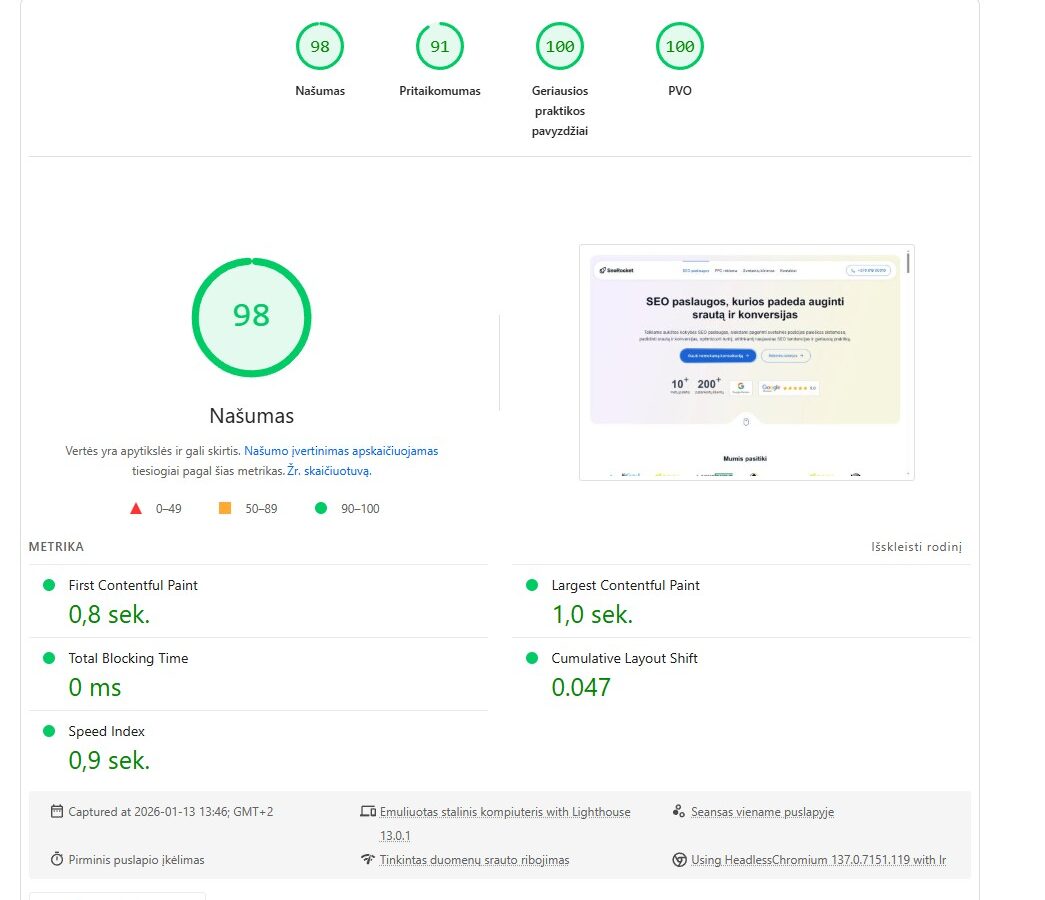
Suitable performance tools can identify loading and responsiveness problems. Distinguish a laboratory test from real-user data.
You can check the page with https://pagespeed.web.dev/
Test the mobile experience
Slow or unusable pages can frustrate visitors. Returning to search is not, by itself, evidence that Google assigned a particular negative quality signal.
An accessible, usable mobile website can:
-
Help people complete tasks
-
Support confidence in the service
-
Reduce avoidable friction in the conversion process
Assess those outcomes with appropriate evidence rather than assuming that every mobile change improves rankings.
Use internal links deliberately
Useful internal links help visitors and crawlers reach relevant pages.
Practical principles include:
-
Use clear, descriptive anchor text.
-
Link to related pages that help with the task.
-
Avoid repetitive links added without a useful reason.
These links help explain how the site's subjects relate and make its structure easier to navigate.
Other foundations
Also review:
-
A logical website structure
-
Important pages accessible for crawling and eligible for indexing
-
Relevant editorial links earned through useful work
These elements support the wider SEO plan.
Resolve significant foundational constraints before investing in a more elaborate optimisation tactic.