AI-assisted content appears in many formats. But how useful is it for SEO ? This guide explains how generation works, where it can help and which checks are needed before publication. No process can guarantee that a page will retain or improve its search position.
Automated content production is readily available, but the volume of material it produces is not a measure of its usefulness. A Europol report on deepfakes discusses the implications of synthetic media. Forecasts quoted in such reports should not be presented as a measured share of all current internet content, or as a precise prediction for “next year” without a date and definition.
AI-generated material includes more than articles. It can involve website interface copy, images, explanations, audio and video, each with its own quality and rights considerations.
Used for a defined task, AI may reduce some drafting or production work. Whether that contributes to search visits or conversions depends on the finished material and the wider offer. Unchecked output can introduce errors and undermine trust.
The following sections address these questions:
- How does AI-generated content work?
- What ethical and environmental issues should be considered?
- What does Google's guidance say?
- When can AI help SEO work, and when can it create problems?
- Which kinds of task can it assist?
- How can a team use it responsibly?
What is AI-generated content?
AI-generated content is text, imagery, audio or video produced by a computational model in response to inputs. People may still supply the brief, source material, edits and final judgement. The term describes a production method, not a guarantee of originality or accuracy.

Different tools support different types of output.
Examples include:
- „ChatGPT” can assist with text drafts, research tasks and code. Other conversational tools include “Claude“, „Google Gemini“, „Microsoft Copilot” and “Perplexity“.
- „Jasper AI” focuses on marketing workflows, including drafts for social posts and advertising copy. Check the particular subscription's features before relying on them.
- „Midjourney” and “DALL·E” are examples associated with image generation. Product names and model availability change; verify the current tool and its terms before production.
- „Lumen5” is an example of a platform for creating video content. A generated draft still needs checking for visual accuracy, wording and appropriate use.
Generation, automation and assistance
AI can also help organise ideas, locate possible sources or suggest edits. A model's proposed source or fact check is not verification until the underlying evidence has been opened and assessed.
Choose the level of human review according to the subject, audience and consequences of an error, rather than treating review as optional for every task.
AI-generated content
A person supplies instructions and the system generates a draft or other output. That output can then be checked, revised or rejected.
Automated content production
A process generates material with little intervention for each item. For example, a catalogue workflow might propose product titles when an item is added. Such a process still needs accurate source data, validation and responsibility for failures.
AI-assisted content creation
AI supports part of the work without replacing the whole editorial process. It might organise supplied evidence, propose an outline or suggest questions for further research.
How AI creates content
Understanding the broad generation process helps explain both the possibilities and the limitations of these tools.
Models learn statistical patterns from training data and use those patterns when producing output. The architecture, data and training methods vary between systems; one explanation does not describe every AI application.
Why the output can resemble reasoning
Fluent answers can resemble human reasoning. That appearance does not establish that the model has human experience, emotions or a reliable understanding of every claim it makes.
An artificial neural network is a computational system with interconnected numerical units. Its name was inspired by biological neurons, but it should not be treated as a literal model of a human brain.
The units are organised into layers that transform input representations. In an image model, some learned patterns may relate to edges or shapes, but a layer does not necessarily have a single human-readable job such as recognising colour.
For example, an image classifier may use learned visual patterns to distinguish a chair from other objects. This is a simplified illustration: it does not mean the system explicitly reasons through legs, a seat and a backrest in the same way a person might.
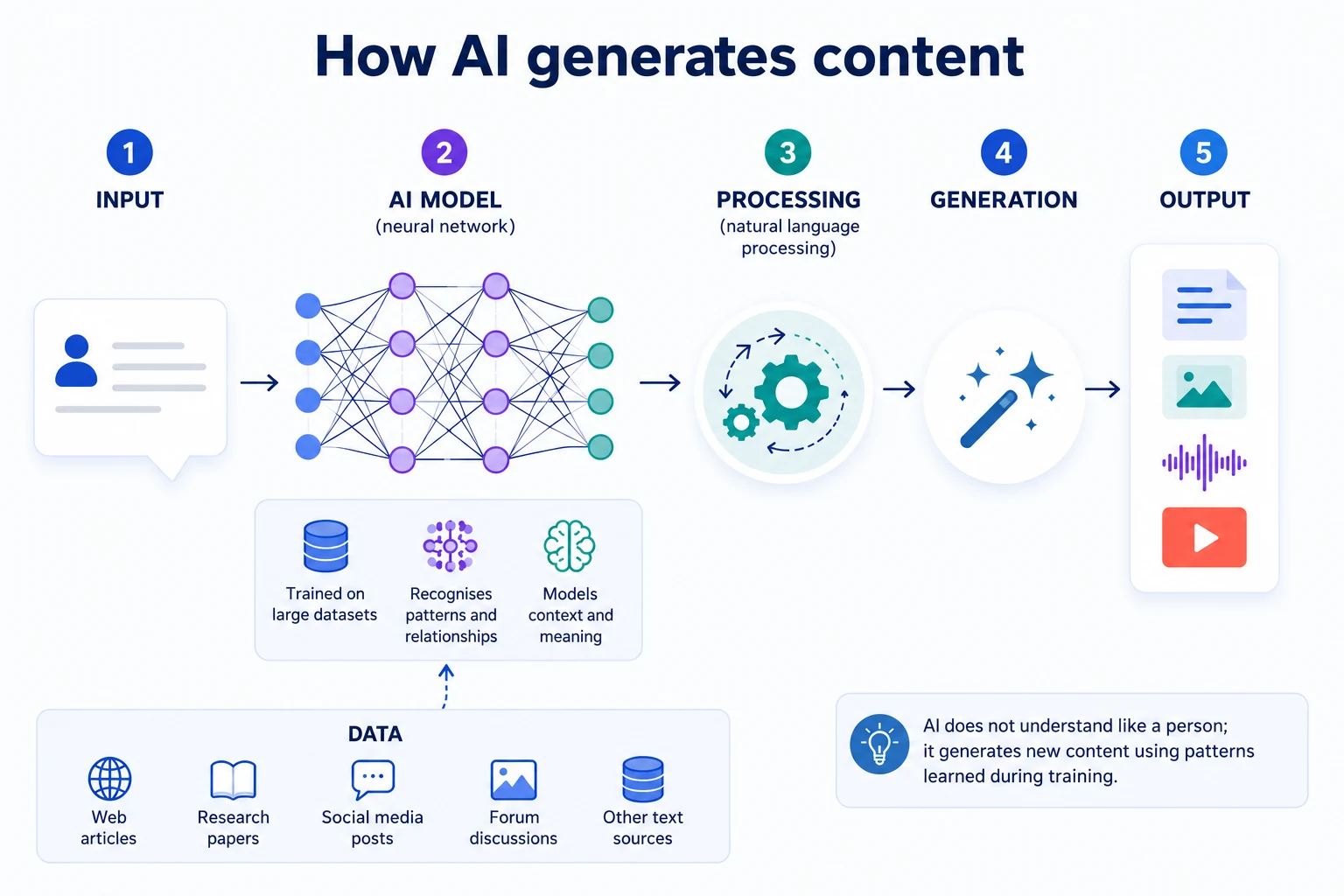
Conversational systems such as ChatGPT use large language models, or LLMs, as part of the product. The surrounding application may also provide retrieval, tools or other processing.
A language model learns relationships in language and can use the context provided to generate a response. The resulting fluency does not establish that the response is factually correct.
Natural language processing
Natural language processing, or NLP, covers computational approaches to working with human language.
The field includes tasks such as translation, text classification, speech transcription and language generation. Not every NLP system is a generative language model.
Google's explanation of natural language processing describes methods for analysing and generating language. It is a broad technical field rather than a synonym for every conversational AI product.
Large language models combine approaches including:
- large neural networks
- substantial training datasets
Depending on the system and its permissions, training material may include:
- web articles
- research publications
- social media material
- forum discussions
- other text sources
Training adjusts model parameters to represent patterns in that material. Specific datasets and their provenance differ, and may not be fully disclosed.
Models that predict sequences
Many language models generate text by predicting successive tokens, which can be words or parts of words. A plausible continuation is not necessarily a true statement or a newly researched fact.
Many products offer a chat interface or API through which a person supplies instructions, often called a prompt.
For a marketing task, a prompt serves a similar purpose to a brief: it explains the goal, audience, available evidence and required output.
The system processes those inputs and generates an output. Its interpretation can differ from the user's intention, so the result needs checking.
Beyond text generation
Image, audio and video tools may also accept natural-language instructions. Their generation methods and output constraints differ from those of a text model.
Some image-generation systems use diffusion methods, which learn to recover structure from noisy representations. This is one family of approaches, not a confirmed description of every version of DALL·E, Midjourney or another proprietary service.
A rough analogy is an image emerging from visual noise. The analogy helps explain the idea of denoising but leaves out much of the mathematics and should not be mistaken for a complete technical account.
Tools can also assist with concepts for:
- website layouts
- logos
- print designs
- marketing visuals
Design judgement, production specifications and rights checks still matter when these drafts become deliverables.
Video generation also needs consistency across frames. A convincing individual frame does not mean that movement, objects and continuity remain accurate through a sequence.
What a model can produce depends on its architecture, training, inputs and tools. More training data does not by itself make a system capable of generating every kind of content.
Audio models may be trained for tasks involving:
- music
- speech
- environmental sounds
- sound effects
Different audio systems learn different representations and generation processes. Check the rights and permissions for voices, recordings and music used in a project.
Accuracy and bias in language models
Training data affects model behaviour, including its errors and biases. The prompt, retrieval sources, system design and later training also influence the output; a careful input cannot guarantee a correct answer.
There is no single accuracy percentage for generative AI across subjects and tasks.
Benchmarks test a defined set of questions under particular conditions. A reported score applies to that test, model version and evaluation method; it does not establish the reliability of every marketing answer. Treat figures such as 85–88% as benchmark-specific claims requiring an identified source, not a general accuracy rate.
Models can also reproduce or amplify biased associations in the material and processes used to train them.
Research on language-model biashas investigated associations involving gender and other characteristics. Findings depend on the models and tasks studied; they should not be presented as identical behaviour in every product. Relevant areas include:
- race
- religion
- age
- disability
A further problem is hallucination: output that sounds plausible but contains fabricated or incorrect information. This can occur even when the system sounds confident. Missing knowledge, ambiguity and generation methods can all contribute.
What to remember
Review generated material critically. Check important facts against evidence, and apply a level of expert review appropriate to the subject before publishing.
AI-generated content and SEO
Google does not prohibit content merely because AI assisted its creation. Its guidance emphasises usefulness and quality, alongside compliance with search policies.
Google's approach to AI content
ChatGPT was publicly introduced in late 2022. In February 2023, Google published guidance on AI-generated content.
that explained its focus on original, useful, high-quality information.
The production method alone does not establish whether an answer is good. Evaluate whether the finished material is accurate and genuinely helpful.
Low-quality material can be produced by people or through automation. The useful distinction is what the content contributes, not a blanket assumption that one method is always acceptable and the other always prohibited.
AI-assisted work must also satisfy spam policies. Producing many pages does not compensate for a lack of added value.
Google's guidance on using generative AI explains that:
Generating many pages without adding value for users may violate its scaled content abuse policy.
It also describes possible uses in research and organising original material, with manual checks for accuracy and trustworthiness before publication.
Quality-rater guidance considers effort, originality and added value. It does not mean that every AI-assisted page is automatically low quality, and individual rater scores do not directly determine rankings.
What this means in practice
Prioritise the reader's task rather than output volume. Review the facts, evidence and explanations, not just whether the prose sounds natural. An edited but unsupported claim remains unsupported.
How poor AI content can create SEO problems
Search systems aim to provide relevant, useful information. A page created mainly to capture queries without answering them is a poor editorial investment, whatever tool produced it.
Low-value pages may struggle to gain or retain visibility. A specific decline still needs investigation; it should not automatically be attributed to AI use.
Google's scaled content policy addresses mass production that adds little value, whether the work is automated, human-produced or a combination.
Experiments on AI-built sites can provide observations about a particular setup, but they do not isolate a universal penalty for using AI. Assess the sample, dates, controls and other site changes before applying the result to your own website.
Potential explanations for a visibility change may include:
- a documented manual action
- a ranking-system change
- spam detection or other technical and content issues
Those are hypotheses until supported by evidence. Temporary rankings do not establish that a low-value publication strategy is sustainable.
Why AI drafts can feel generic
A generic prompt often produces a generic answer. Models generate new sequences from learned patterns, but output can still resemble existing text or repeat familiar claims. Neither originality nor copying should be assumed without checking.
Provide a specific purpose, verified evidence and an editorial direction. This gives the draft a better basis, though a detailed prompt cannot replace fact checking or originality review.
Asking a model to invent topics and draft one without supplying research may produce material little different from common explanations elsewhere. Compare the result with what readers can already find.
Ask what the page adds: a clearer answer, a useful calculation, documented experience or relevant evidence. Adding words without improving the answer does not establish search value.
How AI can support useful SEO work
AI can be a useful assistant when the team has a clear brief and a reliable review process. Measure the whole workflow, including corrections, rather than counting only the time to generate a draft.
Useful coverage of additional audience questions may create further search opportunities. More published pages alone do not guarantee traffic.
AI may also assist reviews of existing pages, such as identifying unclear wording or questions the page does not answer.
The final decision should rest on usefulness and evidence. Verify recommendations against the actual page, audience and available performance data.
Possible assistance includes:
- drafting detailed article outlines
- suggesting SEO research questions
- finding possible information sources
- organising claims for fact checking
- reviewing existing explanations
- proposing changes for an editor to evaluate
A model can suggest revisions when given text and a clear task. Without the live page, search context or actual data, those suggestions should be treated as starting points, not a completed SEO audit.
Specialist platforms, including Semrush's content tools, offer additional workflows. Check the current product, source data, plan limits and purpose before relying on a recommendation.
The practical sections below show how to combine assistance with accountable editorial decisions.
that explained its focus on original, useful, high-quality information.
The production method alone does not establish whether an answer is good. Evaluate whether the finished material is accurate and genuinely helpful.
Low-quality material can be produced by people or through automation. The useful distinction is what the content contributes, not a blanket assumption that one method is always acceptable and the other always prohibited.
AI-assisted work must also satisfy spam policies. Producing many pages does not compensate for a lack of added value.
Google's current Search Central guidance explains that:
Generating many pages without adding value for users may violate its scaled content abuse policy.
It also describes possible uses in research and organising original material, with manual checks for accuracy and trustworthiness before publication.
What this means in practice
Prioritise the reader's task rather than output volume. Review the facts, evidence and explanations, not just whether the prose sounds natural. An edited but unsupported claim remains unsupported.
How poor AI content can create SEO problems
Search systems aim to provide relevant, useful information. A page created mainly to capture queries without answering them is a poor editorial investment, whatever tool produced it.
Low-value pages may struggle to gain or retain visibility. A specific decline still needs investigation; it should not automatically be attributed to AI use.
Google's policy on scaled content abuse addresses generating many pages without sufficient value for users.
One source linked here is SE Ranking's AI content experiment. Its observations should be read with the experiment's methods and limitations, rather than being offered as proof that every AI-written site will lose rankings.
Potential explanations for a visibility change may include:
- a documented manual action
- a ranking-system change
- spam detection or other technical and content issues
Those are hypotheses until supported by evidence. Temporary rankings do not establish that a low-value publication strategy is sustainable.
Why AI drafts can feel generic
A generic prompt often produces a generic answer. Models generate new sequences from learned patterns, but output can still resemble existing text or repeat familiar claims. Neither originality nor copying should be assumed without checking.
Provide a specific purpose, verified evidence and an editorial direction. This gives the draft a better basis, though a detailed prompt cannot replace fact checking or originality review.
Asking a model to invent topics and draft one without supplying research may produce material little different from common explanations elsewhere. Compare the result with what readers can already find.
Ask what the page adds: a clearer answer, a useful calculation, documented experience or relevant evidence. Adding words without improving the answer does not establish search value.
How AI can support useful SEO work
AI can be a useful assistant when the team has a clear brief and a reliable review process. Measure the whole workflow, including corrections, rather than counting only the time to generate a draft.
Useful coverage of additional audience questions may create further search opportunities. More published pages alone do not guarantee traffic.
AI may also assist reviews of existing pages, such as identifying unclear wording or questions the page does not answer.
The final decision should rest on usefulness and evidence. Verify recommendations against the actual page, audience and available performance data.
Possible assistance includes:
- drafting detailed article outlines
- suggesting SEO research questions
- finding possible information sources
- organising claims for fact checking
- reviewing existing explanations
- proposing changes for an editor to evaluate
A model can suggest revisions when given text and a clear task. Without the live page, search context or actual data, those suggestions should be treated as starting points, not a completed SEO audit.
Specialist platforms, including Semrush's content tools, offer additional workflows. Check the current product, source data, plan limits and purpose before relying on a recommendation.
AI content and AI Overviews
AI Overviews may cite pages produced through different editorial methods. The presence of a citation does not tell you which parts of a page were written by a person or assisted by AI.
An AI-detector classification is not direct evidence of authorship. A claimed share of cited pages identified as AI-written depends on the detector, sample, threshold and study date.
Detection tools can misclassify both human and generated text. A high accuracy figure from one test should not be applied to every language, model or mixed editorial workflow.
Even a reliable association would not show that AI production caused the citation. Do not choose a production method simply to imitate an unverified percentage in an AI-search study.
Ethics and environmental considerations
Responsible AI use also involves rights, permissions, disclosure and resource use. Technical capability alone does not decide whether a particular application is appropriate.
Intellectual property
Questions arise about both the information used for training and the material supplied during a project.
Public accessibility does not mean that a work is free of copyright or other restrictions. Rights and applicable exceptions depend on the material, use and jurisdiction; do not infer permission merely because an image or text appears online.
These concerns affect professions including:
- writers
- illustrators
- designers
- other creative specialists
Using a named artist's identity to imitate their work can create concerns beyond simple visual quality. The example of illustrator Greg Rutkowski is often discussed in this context; an exact prompt count should be checked against its dated source, rather than repeated as a current total. Generated work must not be falsely attributed to the artist.
Creators may object to copying, misattribution or uses they have not authorised. AI adoption can also affect creative jobs and commissioning practices; those effects should not be dismissed as impossible.
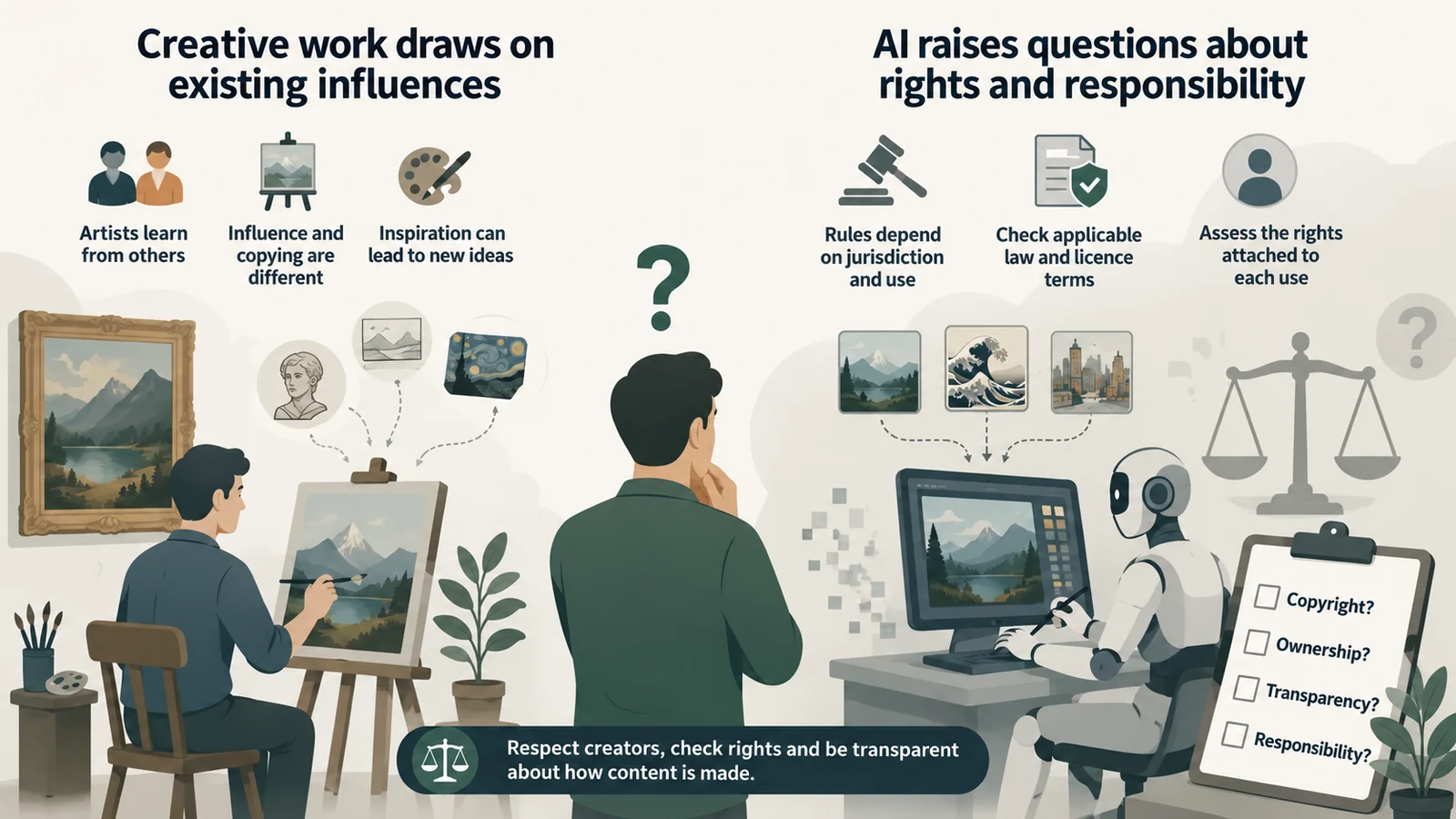
Inspiration and copying
Learning from a creative influence is not automatically the same as having permission to reproduce protected material or imply an endorsement. Assess the actual output and use, not just the wording of the prompt.
AI is not an unregulated space. Existing law and the EU AI Act can be relevant, with duties depending on the system and use. Obtain appropriate legal advice for a high-risk or uncertain application rather than treating personal comfort as the only criterion.
A practical precaution: Use tools that help you locate underlying sources, then open and verify them. A citation from Perplexity, Gemini or another assistant does not grant reproduction rights or guarantee that the cited source supports the claim.
Environmental impact
Environmental discussions, including MIT's analysis, examine electricity, water and hardware resources. The impact depends on training and deployment choices as well as the task. A single universal footprint per prompt would hide important differences. The IEA report on energy and AI examines electricity demand and the wider role of AI in the energy system. It does not establish one universal footprint for every prompt or content workflow.
For an organisation, a practical approach is to consider whether the task is useful and whether a smaller or less resource-intensive process would serve it.
Compare options on a clear basis and avoid unsupported claims that every AI request is either environmentally negligible or worse than every alternative. The purpose, model and full workflow matter.
Does AI fit your brand?
Each business should assess how AI fits its audience, communication standards and values.
An environmental organisation may face different expectations from a technology supplier, but neither should assume how its audience will react without evidence. Explain important uses honestly and avoid presenting generated work as documented experience.
Using AI-generated content responsibly
The following recommendations put these considerations into an editorial workflow.
The examples use a fictional cat-café business, Purrcolator Café. They are teaching scenarios, not client results or evidence of health benefits.
Connect AI use with business goals
Fast generation has little value if the material does not serve an audience need or business purpose. Define why a page should exist before producing it.
For example, a cat café could attract readers with pet-care articles without necessarily attracting café visits. Someone researching a cat they already own may have a different need from someone looking for a place to visit.
Start with the purpose of the content, rather than the number of articles you can generate.
| Goal | Content format | Example |
|---|---|---|
| Relevant enquiries | Landing pages | “Book a visit” |
| Search visibility | Informational articles | “Cats and stress: what does the evidence say?” |
| Demonstrating genuine experience | Expert content | “How we planned a cat-friendly café” — using documented work rather than invented experience |
Include the editorial task in your prompt
A vague request such as “Write an article about ten popular cat breeds” leaves important editorial decisions unspecified.
It does not identify the audience, purpose, evidence or scope. The resulting draft may miss the task even if it includes relevant words.
Specify what matters, but do not assume that an instruction guarantees compliance. Check the result against the brief.
Include useful SEO and editorial requirements in the task, alongside the actual research.
- Keywords — first carry out keyword research and supply relevant queries as context. Do not require unnatural repetitions or assume that mentioning a phrase guarantees search visits.
- Intent — explain what the reader is trying to learn or do and what information would fulfil that task.
- Structure — specify an appropriate format and proposed sections. Headings, lists and FAQs should organise useful information rather than appear simply because a template requires them.
- Entities — identify relevant people, places, products, organisations or concepts that need clear explanation. Search engines use relationships between information in its systems, but adding a list of entity names does not activate a guaranteed ranking benefit.
- Internal links — supply valid, relevant target pages and ask for links where they genuinely help the reader. Check the chosen anchors and destinations against the site structure rather than accepting generated URLs without verification.
- External sources — link to evidence that actually supports a material claim. A prestigious domain or citation list does not make an unsupported statement reliable.
- Structured data — AI may draft code for relevant markup, but it must match the visible page and the applicable feature requirements. Validate it and check for duplication with existing components before implementation.
What this looks like in practice
- draft a 250–500-word article as a brief-specific starting range, not an SEO requirement
- address the supplied relevant queries naturally
- use a clear, friendly tone
- include a relevant, verified link to the supplied cat-breed article
- use headings about appearance, temperament and care where the supplied facts support them
- use only the supplied verified details about the cat
The first draft need not be the final version
The first generated version is a draft, not an obligation to publish.
If the draft misses the purpose or becomes overly promotional, revise the brief or edit the specific passages. Regenerating the whole article is not always the most useful response.
Options include:
- adjusting the tone
- removing unnecessary sales language
- rewriting unclear sentences
- evaluating another suitable tool
If every paragraph asks readers to visit the café, remove the repetition and restore the page's informational purpose. A single relevant next step may be enough; not every paragraph needs a call to action.
Consider experience, expertise and trust
Google's quality guidance discusses E-E-A-T.
— experience, expertise, authoritativeness and trustworthiness. These considerations help assess a page's credibility; they are not a single score that a model can add to a draft.
People expect different expertise for different subjects. Medical information needs a suitable basis and review, rather than merely confident writing. The same principle applies when considering E-E-A-T in a page's editorial process.
Identify who is responsible for the material and what supports important claims. An author label alone does not establish quality, and no byline guarantees a higher ranking.
A model is not a practitioner with first-hand experience. Useful evidence, where relevant, can include:
- verified statistics
- attributable expert commentary
- documented facts
- appropriate primary sources
Make clear which source supports which claim. Obtain permission where necessary and do not fabricate an expert endorsement.
Specify evidence requirements in the brief, then verify the actual material during editing. A model-generated reference still needs checking.
This approach can help:
- give readers a sounder basis for trust
- produce clearer, more useful search content
- make expertise and evidence easier to assess
Use AI to assist analysis as well as drafting
A model can draft a whole article, but it may be more useful to assign smaller, well-defined tasks.
Assistance can extend beyond prose to organising questions, identifying gaps or comparing supplied material. Keep strategic decisions grounded in evidence from your audience and website.
The value depends on the task and the review needed, not a universal claim that one use of AI is always best.
Query groups
Query grouping considers related searches together rather than treating every phrase as a separate page opportunity.
This can help organise coverage around a subject and avoid duplicating explanations. It does not guarantee that a page will rank for more queries simply because a cluster exists.
Entities and context
In this context, entities can include:
- brands
- people
- organisations
- products
- places
- events
Explain relevant objects and their relationships accurately. Merely naming them does not establish a connection to Google's Knowledge Graph or confer authority.
Clear context helps readers understand the subject and reduces ambiguity. Treat claims about additional search effects as hypotheses unless evidence supports them.
Understanding the reader's intent
Content planning also needs to consider the reader's goal.
Intent research asks:
- what information the person needs
- which problem they are trying to solve
- what kind of answer would be useful
Use those questions to decide what belongs on the page and what can be left out.
A practical example
Suppose the fictional café is considering an article about cats and wellbeing.
A model could help propose:
- related groups of research questions
- relevant concepts and sources to investigate
- possible reader intentions
It might suggest themes involving stress or companionship. Those suggestions are not evidence of a health benefit; the editor would need suitable research and should avoid presenting a café visit as treatment.
The tool can therefore help organise a research plan, while the team remains responsible for deciding what the evidence supports.
Combining human judgement with automation
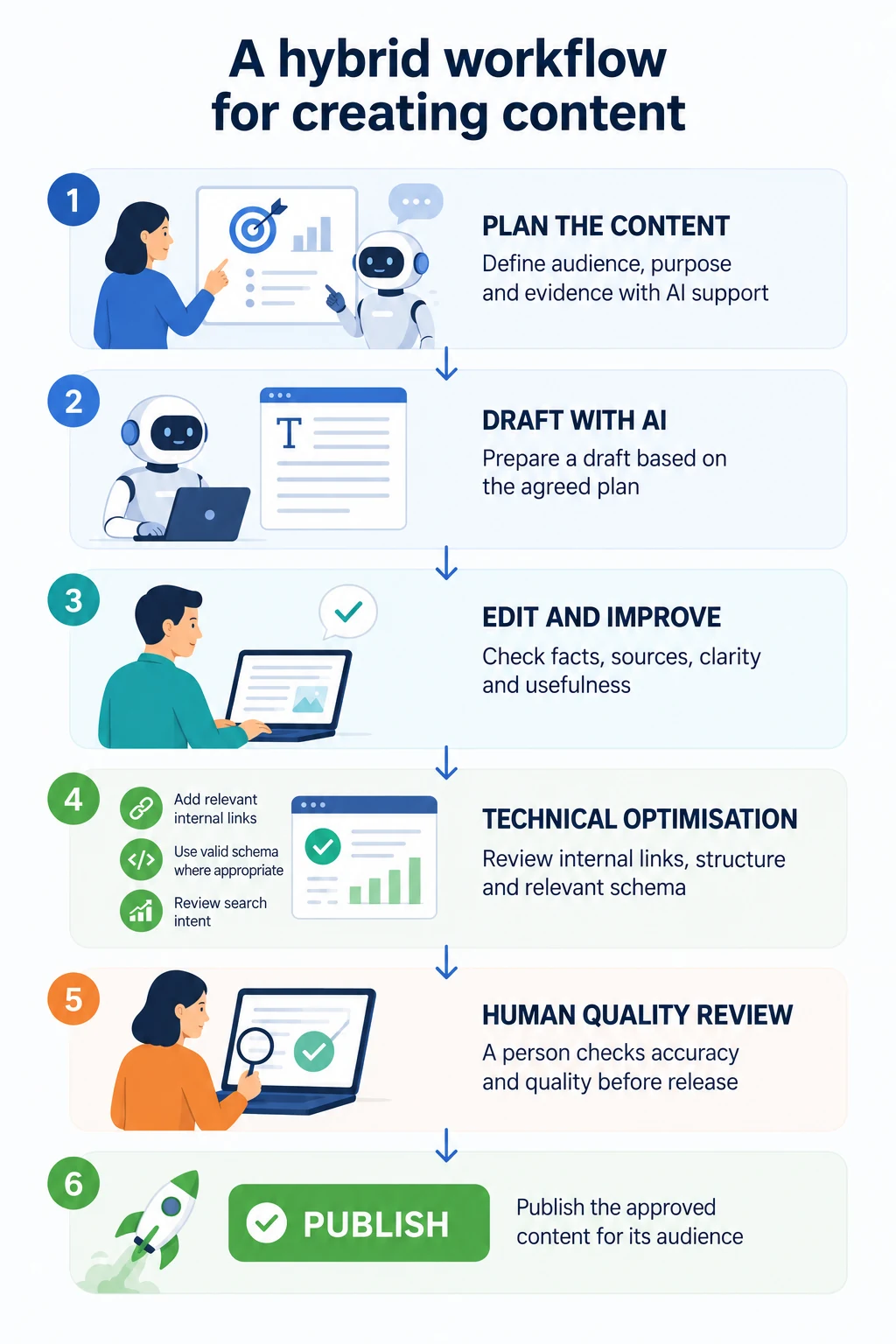
A combined workflow gives people responsibility for the brief, verification and publication, with automation assisting defined tasks.
Whether it saves time depends on the complete process, including errors and revisions. Set a quality standard before measuring production speed.
Plan the content with AI assistance
- Organise supplied queries and investigate audience needs
- Propose ideas for editorial assessment
- Draft a plan to check against actual research
Prepare an initial draft
- Generate a draft from the approved brief and evidence
- Use it as a starting point for revision
- Reserve time for substantive quality checks
Edit and refine the instructions
- Verify facts and review the language
- Remove repetition and generic phrasing
- Revise the prompt or the draft where necessary
Review technical and SEO elements
- Check relevant internal links and destinations
- Validate any generated structured data
- Review query coverage without forcing repetitions
Complete a responsible human review
- Assess accuracy, usefulness and readability
- Check whether expertise and evidence are represented honestly
- Align wording with the brand's communication standards
Publish and monitor
- Publish only after the required review
- Monitor actual outcomes rather than guaranteeing long-term SEO gains
- Balance efficiency with the standard the audience needs