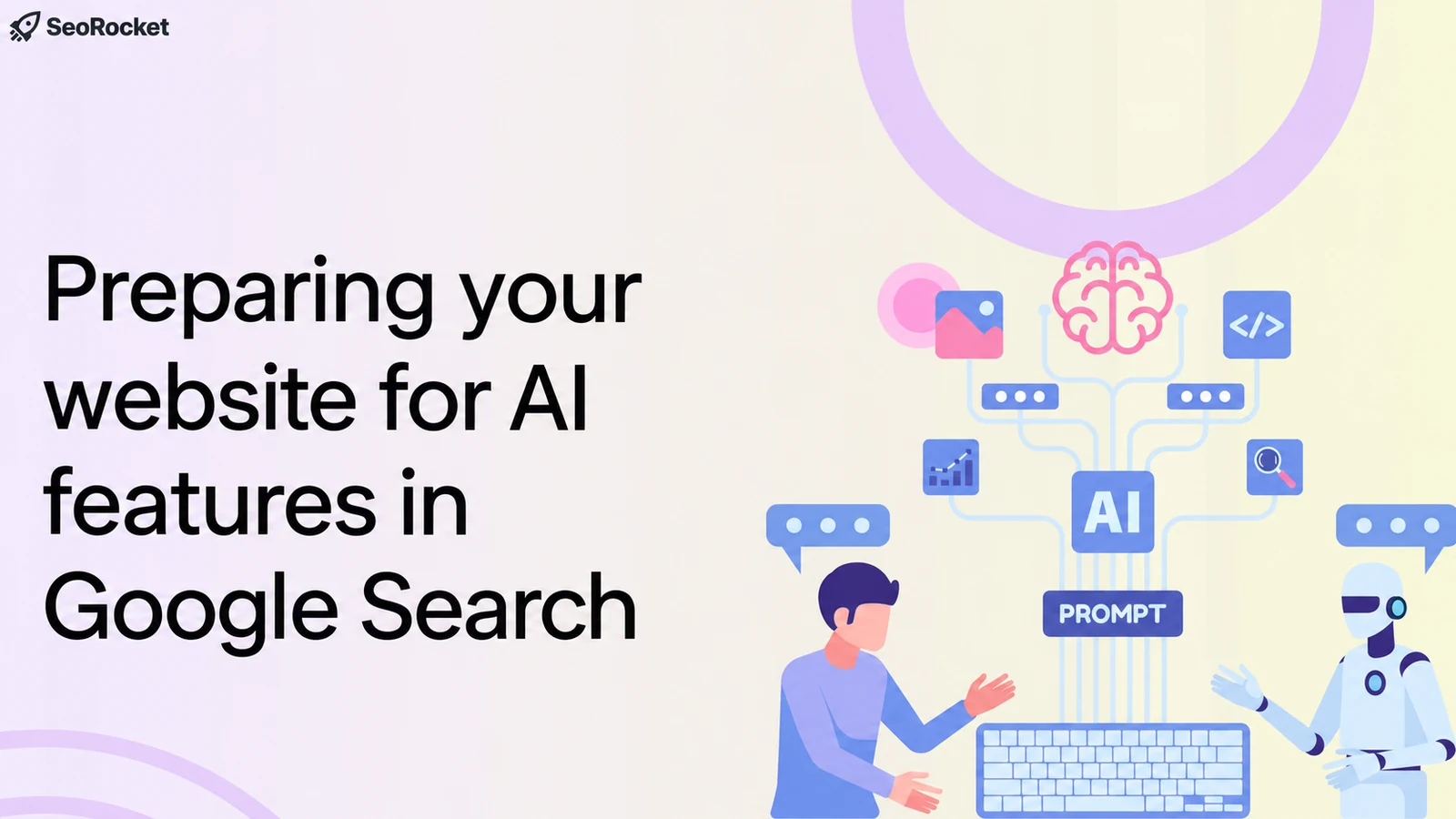
Generative AI introduces new ways to search for and evaluate information. As Google Search incorporates these experiences, website owners need to understand how useful pages can be discovered and referenced. A visit may lead to further reading, a subscription or a purchase, but those outcomes need to be measured rather than assumed.
This guide is for website owners who want to follow Google’s published search guidance and understand eligibility for features such as AI Overviews and AI Mode.
Yes, it remains relevant. SEO fundamentals still matter because Google’s generative AI search features use its underlying search and quality systems to find relevant information in the search index.
Several concepts help explain this:
- Retrieval-augmented generation. Grounding an answer in retrieved information helps a system connect its response with relevant sources. Search systems find suitable pages, and the AI feature can use information from them to develop an answer with supporting links. This does not guarantee that a particular page will be selected or that every generated statement is correct.
- Query fan-out. A system can issue several related searches to investigate different aspects of a question. For example, a question about a weed-covered lawn might lead to searches about treatments, chemical-free removal and preventing regrowth. The purpose is to explore the underlying need, not to require a separate page for every possible wording.
AEO and GEO terminology. AEO stands for answer engine optimisation and GEO for generative engine optimisation. People use these labels for work intended to improve visibility in AI answers. For Google Search, the practical foundations remain part of SEO: useful content, accessibility, indexing eligibility and a good experience for visitors.
Applying SEO fundamentals to generative AI search
The following sections apply those foundations to generative AI search. The aim is to make the website useful and eligible to be discovered in Google’s AI features as well as conventional search results.
Create useful, distinctive content for your audience
Distinctive information that genuinely helps readers is a stronger editorial priority than special formatting tricks. What counts as useful depends on the topic and audience, but several qualities are worth checking.
- A distinct perspective. Contribute knowledge or evidence that is not already available in an interchangeable summary. A first-hand review, for example, can explain what was tested and what happened. Use real experience where you have it, identify its limits and avoid presenting a model-generated account as something you personally did.
- Helpful, reliable, people-first content. Generic advice may not answer the reader’s specific problem. A first-home guide can become more useful when it explains a real inspection finding, the evidence behind a decision and the consequences. The value comes from the detail and reasoning, not from choosing a dramatic conclusion or inventing a personal story.
- A structure readers can follow. Organise information with clear paragraphs, sections and descriptive headings. Help people understand the argument and find the part relevant to their question.
- Relevant, high-quality images and video. Images and videos can answer questions that text alone handles poorly. Use them where they add useful detail and follow normal image and video SEO practices. They can create additional discovery opportunities, but adding media does not guarantee inclusion in an AI answer.
- Meeting the need without unnecessary pages. Do not create a separate page for every imagined query variation simply to influence rankings or AI answers. Large-scale content produced primarily to manipulate search rather than help people can violate spam policies. Distinct pages are justified by distinct needs, not by minor changes in wording.
If you use generative AI during production, review the final work against Search Essentials and spam policies. Check the facts, originality and usefulness rather than treating the generation method as a quality assessment.
A useful decision rule is to ask whether the proposed content helps the intended visitor complete their task. Improve what the reader needs instead of adding material solely to satisfy a supposed AI-search formula.
Maintain a clear technical structure
How Google discovers and processes pages remains important to eligibility for its AI search features. A clear technical structure helps useful content be found and indexed, so established technical SEO practices still apply.
- Meet Google Search’s technical requirements. A page needs to be indexed and eligible to appear with a snippet in Google Search to be considered as a supporting link in AI features. Meeting the requirements does not guarantee crawling, indexing, appearance or citation. Check technical eligibility before attributing an absence to the writing style.
- Follow crawling best practices. Make important public content available to Googlebot and ensure that navigation helps discovery. Crawl-budget management deserves particular attention on very large or frequently changing sites. This is about search access; it should not be confused with granting unrestricted access to every AI-training crawler.
- Use semantic HTML to improve clarity and accessibility. Perfectly structured HTML is not a separate eligibility requirement for AI features. Sensible semantic elements still help browsers, assistive technology and maintainers understand the page. Use headings, lists, labels and navigation elements for their intended purposes.
- Follow JavaScript SEO practices where you use JavaScript. Google can render JavaScript, but blocked resources, failed rendering or interaction-dependent content can prevent important information from being processed. Test what is available in the rendered page rather than assuming a framework guarantees search visibility.
- Provide a good page experience. Make the website usable across devices, reduce unnecessary loading delays and help visitors distinguish the main information from other page elements.
- Reduce unnecessary duplication. Duplicate pages can confuse navigation and consume crawling resources on unimportant URLs. Preserve pages with distinct purposes and consolidate unnecessary variations.
Verify the website in Search Console to investigate technical issues. Use indexing evidence, URL inspection and the site’s technical maintenance checks to identify specific problems.
Keep local business and product information accurate
Where relevant to a query, Google’s AI experiences may include products and local business information. Keep Merchant Center feeds and Google Business Profile details accurate where those products are available and appropriate. Check the current eligibility requirements rather than assuming that creating an account ensures exposure.
For suitable merchants, investigate conversational commerce features such as Business Agent where they are available. Confirm market, account and integration requirements before including them in an implementation plan.
Generative AI search myths: what you do not need to do
As generative search develops, so do theories about how to influence it. Terms such as answer engine optimisation and generative engine optimisation do not establish that a particular tactic works. Ask what evidence supports the recommendation and whether it applies to Google Search.
The following are common areas of confusion. They are not special requirements for appearing in Google’s AI search features:
- llms.txt files and special AI markup. Google does not require a new machine-readable file, AI text file, special markup or Markdown version for its AI search features. Its ability to discover different file types does not mean that a particular additional format receives special treatment.
- Breaking content into tiny chunks. There is no universal requirement to split a subject into very short pages for AI systems. Google can understand relevant passages within a longer page. Choose page length and section structure around the audience’s task rather than an arbitrary chunk size.
- Rewriting solely for AI systems. You do not need a special writing style or every possible long-tail phrasing to be eligible. Explain the topic clearly using language the reader understands. Systems can connect related meanings without an exact match between every query and a sentence on the page.
- Manufacturing mentions. AI features can draw on different public sources, including articles, videos and forum discussions. That does not make fabricated recommendations or spam mentions a sound strategy. Pursue genuine visibility by contributing something relevant, rather than creating an artificial record of approval.
- Do not treat structured data as an AI shortcut. Google does not require special schema.org markup for its generative AI search features. Use appropriate markup for supported rich-result content, matching the visible page.
Consider experiences involving AI agents
AI agents can carry out tasks on someone’s behalf, such as comparing products or making a booking. Browser-based agents may interpret screenshots, inspect the DOM or use accessibility information to understand an interface. These capabilities vary by product and do not remove the need for confirmation on consequential actions.
Where relevant, review how current agents interact with your website. Clear labels, accessible controls and reliable workflows help both people and automated interfaces. Commerce protocols such as UCP are another area to investigate, subject to actual platform support and business requirements.
Next steps: where to focus
Not every website needs every possible optimisation. Establish the basic eligibility and usability of important pages, then prioritise changes that solve a demonstrated problem for your audience.
The main priorities are:
- Apply SEO fundamentals to generative AI search. Maintain accessible pages, a coherent technical structure and useful, distinctive information. These support discovery in conventional search and eligibility for AI features.
- Publish reliable content that adds something useful. Use genuine knowledge, relevant evidence and clear explanations to go beyond an interchangeable summary.
- Choose evidence-based work over AEO or GEO tricks. Do not treat tiny content chunks, unnecessary AI text files or manufactured mentions as requirements for Google Search.
- Follow relevant developments in AI agents. Evaluate browser agents and commerce protocols where they serve a real business need, rather than implementing them solely because they are new.