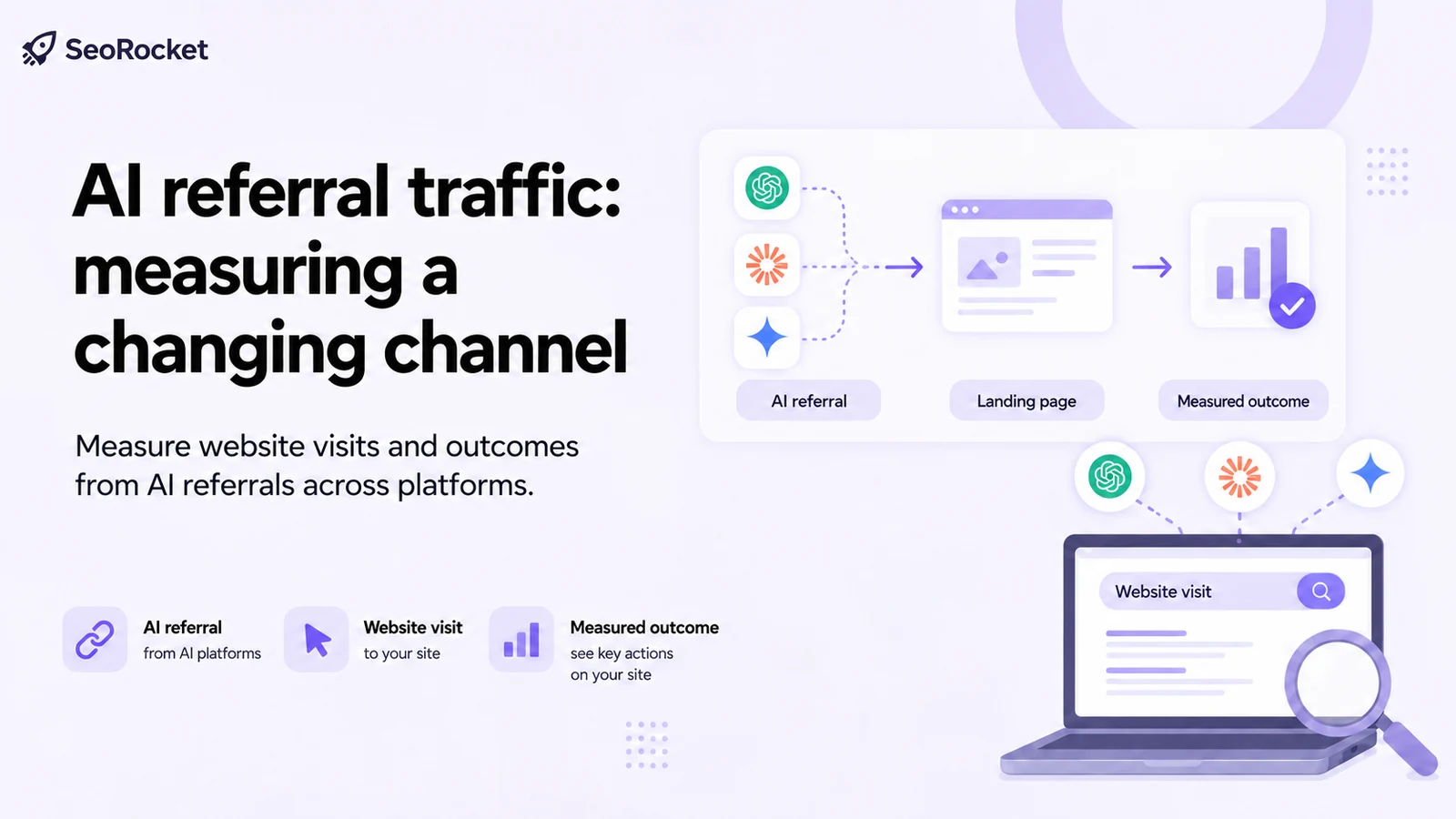
A 2026 Previsible study reports growth and volatility in measurable referrals from standalone AI assistants. Its findings provide questions to investigate in your own analytics, rather than a universal description of every website or the entire AI market.
Expectations about which assistant would become a major discovery channel have changed. This report follows referral sessions to a particular set of websites; it does not establish total platform usage or the value of every interaction that remains inside an app.
Previsible's third AI traffic studyanalysed 6.77 million sessions attributed to large language model platformsacross its sample. Monthly recorded sessions reached 644,478 in May 2026, about 9.9 times the November 2024 level. ChatGPT accounted for 92.4% of the report's measured LLM referrals, not 92.4% of all online discovery.
A pause followed by further growth
An apparent plateau in some sectors during 2025 was followed by renewed growth in the study's later observations.
The source records 65,249 monthly sessions in November 2024, 396,278 in August 2025 and a fall in November 2025. Sessions subsequently reached 428,203 in February 2026 and 644,478 in May. These are counts from the study, not forecasts for an individual business.
The November decline needs context.
The study reports a roughly 50% monthly decline, largely associated with ChatGPT referrals falling from 448,412 to 213,345 sessions. Other platforms were steadier. A product change is one possible explanation, but referral observations alone do not establish its cause. Separate coverage discussed changes in traffic alongside more frequent references to Wikipedia and Reddit. The report records a recovery to 442,609 sessions in December 2025.
The practical lesson is to plan for volatility. A channel concentrated in one provider can change substantially; monitor your own referrals before assigning a cause or changing investment.
A concentrated referral mix
An earlier Previsible report described a different distribution: approximately 84% ChatGPT, 8.9% Perplexity, 4.5% Gemini, 2.1% Copilot and 0.6% Claude. The property pools can differ between studies, so those shares should not be treated as a controlled like-for-like market time series.
Within the newer dataset, ChatGPT's measured referrals increased about 12.8 times over the observation period and its share was dominant. That makes it worth investigating, but your own audience and commercially useful visits should determine platform priorities.
The scope is important: the study measures identifiable referrals from standalone assistants. It excludes Google's AI Overviews, whose traffic is measured differently. It therefore cannot establish the relative volume of all Google AI discovery versus every other AI interaction.
Changes among the smaller referrers
The smaller platforms also show changes worth examining.
Claude
Claude referrals in the sample rose from 133 sessions in November 2024 to 8,528 in May 2026, roughly 64 times the small starting base. The report says Claude passed Perplexity in March 2026 within its observations.
The reported acceleration coincided with broader agentic and professional uses of Claude. Coincidence does not prove that particular integrations caused the referral increase or that the pattern will continue.
For technical buyers, developers or professional-service audiences, inspect Claude referrals and landing pages where the sample is large enough to be useful. Early attention is not a guaranteed competitive advantage.
Gemini
Gemini was the second-largest referrer in this dataset and grew about 3.2 times. Its presence in other Google products may influence discovery that referral sessions do not capture, but that influence is not quantified by this study.
Perplexity and Copilot
Previsible records a Perplexity peak of 17,507 monthly sessions in March 2025 followed by a 61% decline. Copilot fell from an August 2025 peak of 8,651 to 339 sessions, about 96%. These are sample-specific historical changes, not proof that either platform has no value for your audience.
A platform may influence research without producing an identifiable referral. Assess measurable visits alongside relevant audience behaviour and conversion evidence, rather than writing off a channel solely from another dataset's decline.
Where AI referrals land and what to investigate
The destination pages provide another useful line of investigation.
The report attributes 28.8% of ChatGPT referrals to internal search pages. Its broader discussion describes roughly a quarter of AI referrals landing in site search, though the pattern varies by sector.
One interpretation is that an assistant identifies a relevant domain without selecting the most specific URL. The landing-page data does not directly reveal the model's reasoning or prove a universal property of retrieval-augmented generation.
A visitor has nevertheless reached your domain. If they land on internal search, the quality of those results and the next navigation step matter. Do not assume that every such visitor already has high purchase intent.
Test internal search as a genuine entry point, not only a function used by people who arrived elsewhere on the site.
The study describes different landing-page patterns by sector:
- SaaS: search pages account for 34.6% of the sample's AI referrals in this category.
- Publishing: news pages account for 54% of LLM referrals. The current primary report gives AI penetration as 0.08%, alongside more than 120 million organic sessions; this differs from the earlier 0.11% figure in the Lithuanian text. The figures describe the report's sample and denominator, not every publisher.
- Ecommerce: product pages are a main destination. A landing URL alone does not verify how ready the visitor is to buy.
- Education: course pages account for 52% of the category's recorded referrals, indicating that some visits enter directly at course information.
- Health: About pages account for 42.1% in the report's classification. This may suggest a role for clear organisation and expertise information, but it does not directly prove the visitor's motivation.
- Legal services: referrals are distributed across articles, About, contact and location pages. Review the complete enquiry journey rather than assuming that only blog posts attract useful discovery.
The report also proposes differences between platform referral patterns:
- ChatGPT and Gemini show comparatively frequent referrals to search or broader navigation pages in this sample. This is an observed destination pattern, not a direct measurement of domain trust.
- Perplexity and Claude show a stronger association with specific editorial or educational pages in the report. Do not convert that association into a rule that longer content always earns more citations.
Smaller referral volumes can still matter if the visits contribute to a relevant outcome. Compare qualified enquiries or purchases where the data supports it, not merely the overall platform share.
Practical next steps
- Start with the platforms that send relevant visits to your own website. ChatGPT's prominence in this study makes it a useful research starting point, not a mandatory first priority for every business.
- Monitor Claude where it is relevant to your audience. Its historical growth in this sample does not establish a forecast or a guaranteed benefit from early investment.
- Review product pages as entry points. The study reports that they received 43% of ecommerce LLM referrals. Accurate, readable product information is useful, but this percentage does not create a universal technical requirement for all AI platforms.
- Explain pricing clearly where it is practical. For custom work, describe the factors and scope behind a quotation rather than inventing a fixed figure simply to make it machine-readable.
- Check internal search results, empty states and navigation when referrals actually land there. Prioritise observed friction rather than adopting a new search system solely because of an industry average.
- Segment AI referrals by page type and relevant outcome. A site-wide average can conceal concentrations on pricing, product or course pages. A three-times-higher rate is an illustration to investigate, not a prediction for your pricing page.
Referral volume does not answer which visitors become customers. Compare conversion definitions and quality across platforms, and disclose small samples or missing attribution.
Use the study to frame questions for your own measurement. Results may change as products and behaviour evolve, so retain the dates and method with each comparison.
About the data
Previsible's report covers 166 GA4 properties observed from November 2024 to May 2026 across sectors including SaaS, ecommerce, finance, legal services, health, insurance, education, publishing and ticketing. The properties were present throughout that 19-month window, although pools can differ between separate reports. It measures identifiable referral sessions, not all mentions, influence, app activity or global market share.