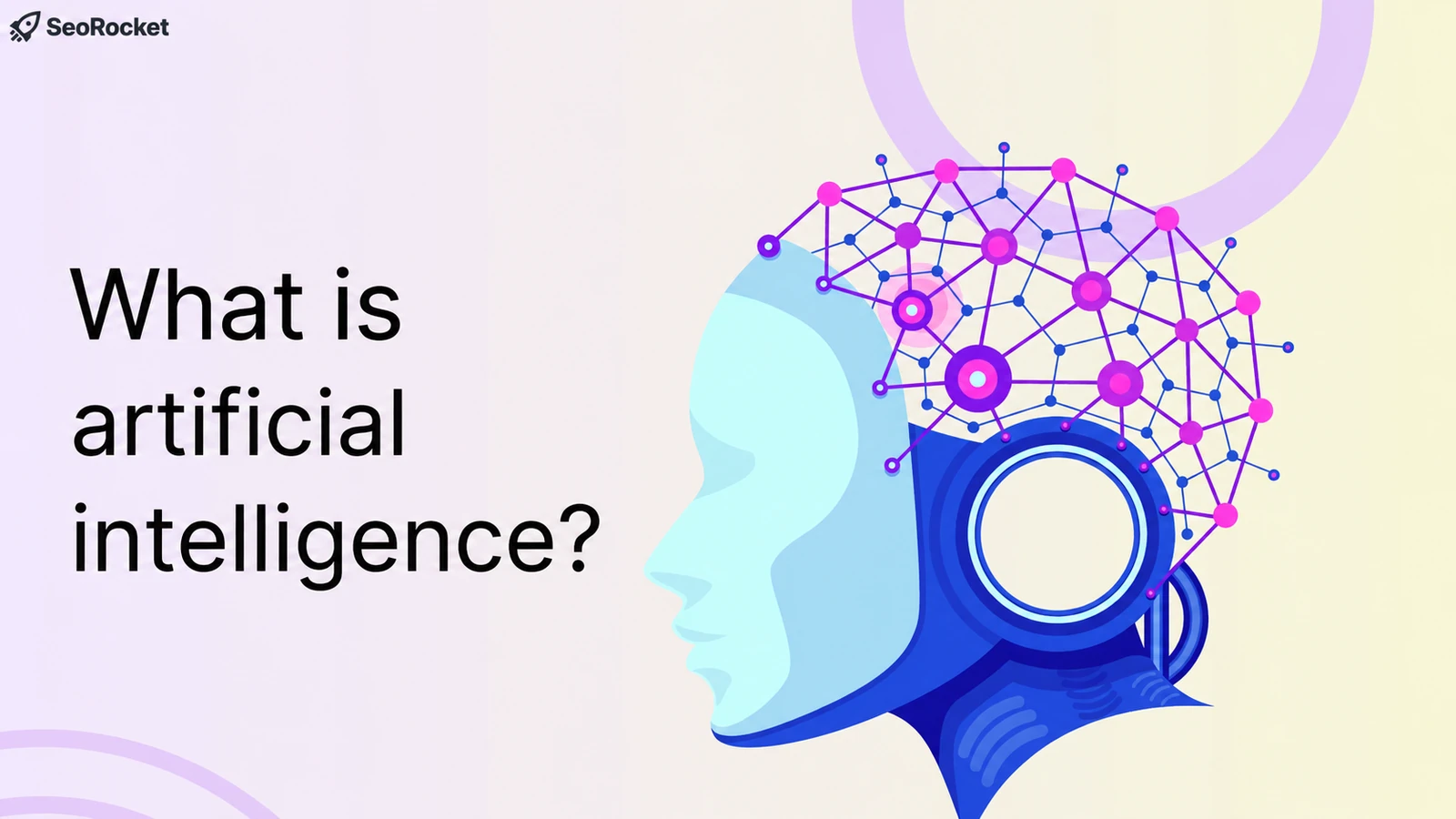
Artificial intelligence, or AI, is a broad field concerned with systems that perform tasks such as prediction, language processing, recognition and decision support. Methods include rule-based systems and learning from data. Applications range from speech recognition and computer vision to generative tools that produce text, images or other content.
AI is often used as a marketing label. Ask what a product actually does, which method it uses where relevant, and how its performance is assessed.
There is no single AI programming language or universal hardware requirement. Python, R, Java, C++ and Julia are used for different purposes. Training a large model can require substantial infrastructure, while some applications use existing models through software services.
How does artificial intelligence work?
Machine-learning systems derive patterns from training data, but not all learning uses labelled examples. Supervised, unsupervised and reinforcement learning address different problems. Training and using a deployed model are separate activities.
For example, a language model can generate plausible responses from learned patterns, and a vision model can classify features in an image. Plausibility is not proof of accuracy. Generative models can produce useful material as well as confident errors.
Core ideas in building AI systems
The following concepts help explain common AI capabilities without implying human consciousness.
Learning
Training adjusts a model using data and an objective. The chosen data, method and evaluation affect what the system can do and where it may fail.
Reasoning
Some systems perform inference, planning or step-based problem solving. Their output still needs evaluation; appearing to reason does not establish that the conclusion is correct.
Correction and adaptation
A system may be updated through retraining, feedback or an explicitly designed learning process. A deployed model does not necessarily keep learning or changing its parameters during ordinary use.
Generation
Models and other computational methods can produce text, images, music or candidate ideas. The output needs checks appropriate to its purpose, including accuracy, rights and safety.
AI, machine learning and deep learning
AI, machine learning and deep learning are related but not interchangeable. AI is the broader field; machine learning is a family of methods within it, and deep learning uses multi-layer neural networks within machine learning.
Machine learning uses data to fit patterns rather than require every decision rule to be written manually. Deep neural networks can learn complex representations, but they do not reproduce the human brain or guarantee human-like understanding. Model choice depends on the task, data and evaluation.
Why AI matters
AI can support or automate parts of customer service, fraud detection, quality inspection and other workflows. The suitability depends on the consequences of error and the controls around the system.
Some systems process suitable tasks faster or more consistently than a manual workflow. That is not a universal accuracy advantage. Legal document review, for example, still requires checks on omissions, context and authoritative interpretation.
Prediction and optimisation can also support digital products, such as matching demand with available services. An application’s commercial success cannot be attributed to AI alone.
Major technology companies use AI in products and research. Language models are one visible application, alongside search, recommendations and computer vision. The transformer architecture is an important development in language modelling, but it is not the only approach to AI.
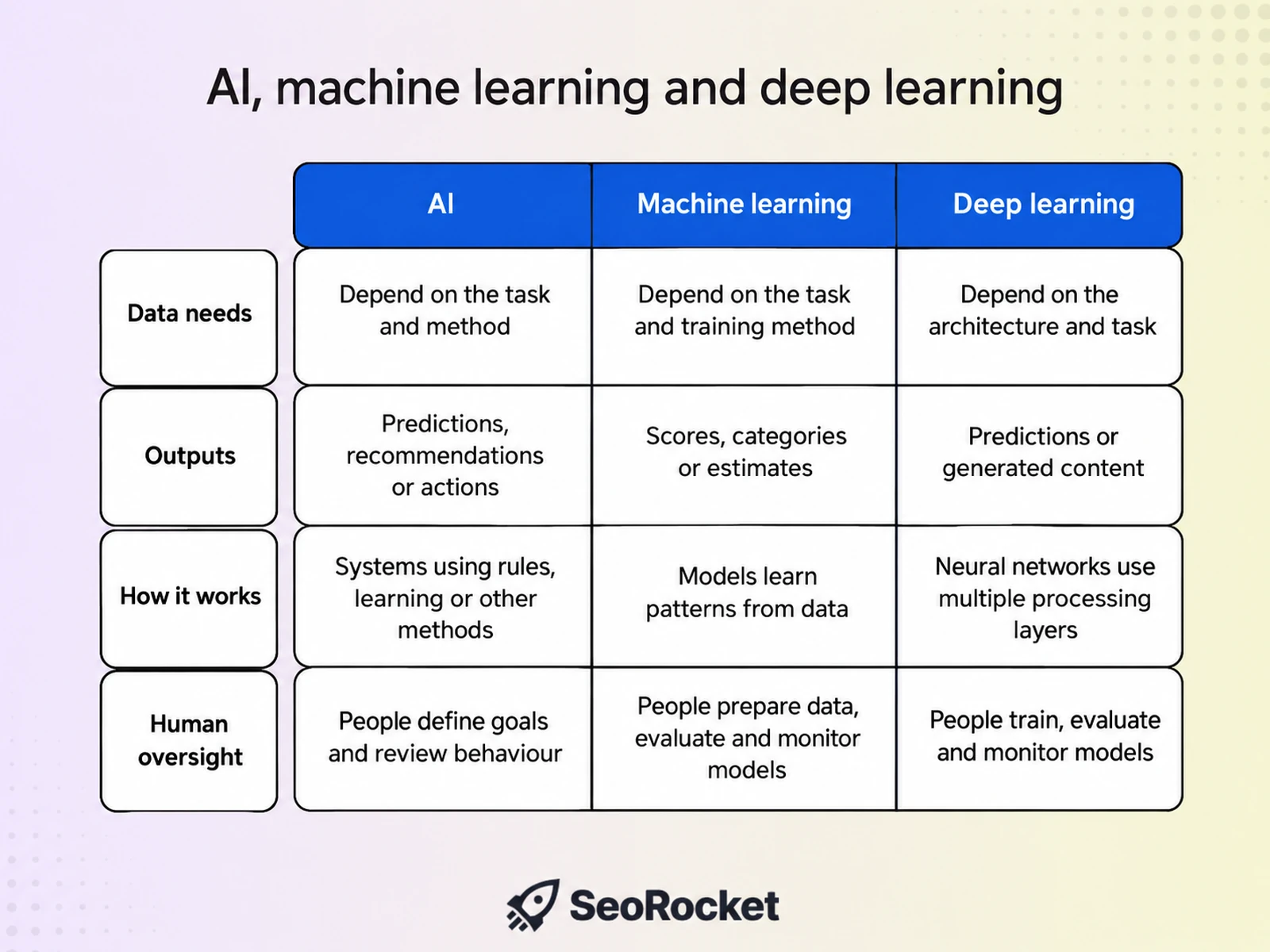
| Comparison | Meaning |
|---|---|
| Data requirements | Depend on the method and task |
| Data requirements | Depend on the task, model and data quality |
| Data requirements | Can be substantial, but there is no universal minimum record count |
| Results | Outputs can include predictions, recommendations or actions |
| Results | Outputs can include classes, estimates, rankings and other values |
| Results | Outputs can include predictions or generated content such as text and audio |
| How it works | Uses computational methods to perform defined tasks |
| How it works | Fits patterns from data using an appropriate learning method |
| How it works | Uses neural networks with multiple processing layers |
| How it is managed | Requires suitable design, evaluation and oversight |
| How it is managed | Requires data preparation, validation and monitoring |
| How it is managed | Still requires monitoring, evaluation and maintenance after deployment |
Benefits and limitations
AI can help process large datasets and find patterns that would be difficult to inspect manually. Whether that produces a useful insight depends on the data, the objective and validation on relevant cases.
Costs, bias, unreliable output and inappropriate use remain important limitations. Consider these before implementation rather than after the system is already part of a consequential decision.
Potential benefits
Pattern recognition
A model may identify useful patterns in a defined task, such as flagging a possible manufacturing defect for review. Performance must be tested on representative cases rather than assumed from a demonstration.
Processing at scale
Automation can shorten suitable analysis tasks. A prediction remains an estimate, and consequential financial or healthcare use requires domain-specific validation and oversight.
Reducing repetitive work
AI-enabled equipment and software can assist with repetitive or hazardous tasks when the wider process is designed and operated safely.
Consistency
A system can apply a defined procedure repeatedly, but consistent mistakes are still mistakes. Translation and document-analysis output need quality checks.
Personalisation
Recommendation systems may adapt content or products to recorded preferences. Assess relevance, data use and whether the recommendations help the user.
Extended availability
An automated assistant can be available outside office hours, subject to service reliability and limits. Provide a way to escalate issues that it cannot resolve.
Scaling a workflow
Automation may support increased volumes in search or business analytics , but infrastructure, cost and review capacity can become constraints.
Supporting research
Models and simulations can help researchers generate or evaluate candidates. They do not replace empirical testing or establish that a proposed discovery is valid.
Environmental monitoring
Data-driven methods can support analysis of sensor or satellite observations, such as changes in land use. The reliability depends on coverage, labelling and validation.
Process improvement
Forecasting and optimisation can support resource planning. Measure the actual operational effect and monitor errors rather than assume efficiency from the use of AI.
Potential disadvantages
Financial costs
Costs may include integration, infrastructure, model access, inference, evaluation and maintenance. Training a large proprietary model is only one possible approach.
Technical complexity
A dependable implementation requires data handling, model or service selection, testing, monitoring and a clear process for failures.
Skills and capacity
A team may need technical and domain expertise it does not currently have. Assess that capacity before committing to the project.
Bias
Training data, objectives and deployment choices can produce or amplify unfair outcomes. Balanced data alone does not eliminate every form of bias.
Limited generalisation
A model may perform well on its evaluation set and fail in a different environment. Test the intended use and monitor changes rather than assume broad competence.
Changes to work
Automation can change tasks, roles and required skills. New opportunities do not necessarily arise for the same people whose work is affected.
Security risks
Potential risks include manipulated data, malicious instructions and unsafe access to tools or confidential information. Controls depend on the application and its permissions.
Environmental impact
Computing and data infrastructure use energy and other resources. The scale of impact depends on the model, workload, location and infrastructure.
Legal and governance issues
Personal data, copyright, accountability and sector rules may affect the intended use. Requirements vary by jurisdiction; an AI tool does not remove the organisation’s responsibility for its decisions.
Further reading
- What Is Artificial Intelligence (AI)?
: IBM’s introduction to the concept and its applications. - Understanding Artificial Intelligence Types
: IBM’s discussion of narrow AI and the concept of general AI. - What Is Artificial Intelligence? (Google Cloud)
: an explanation of AI methods and applications. - AI Index Report – Stanford HAI
: research and data about developments in AI. - What Is Artificial Intelligence? (Coursera Guide)
: an introductory educational overview. - ISO – What Is Artificial Intelligence
: an introduction from the International Organization for Standardization. For risk assessment, see the NIST framework linked below.